https://www.highperformancecpmgate.com/rgeesizw1?key=a9d7b2ab045c91688419e8e18a006621

Alphabet crushes Q2 earnings estimates as Google Cloud cuts losses, grows 54%

Today after the bell amidst a deluge of major technology company earnings reports, Alphabet reported its own second-quarter performance. The search-and-services company posted revenues of $61.9 billion in the June 30, 2021 quarter, net income of $18.5 billion, and earnings per share of $27.26. Those figures work out to top-line growth of 62%, and net income expansion of 166%. Naturally Google is currently being compared to pandemic-impacted Q2 2020 results, but its gains are noteworthy regardless.

The Android-maker’s results trounced expectations, with the street only expecting Google’s parent company to post $56 billion in total top line and $19.14 in earnings per share. Notably Alphabet shares are up around a single percentage point after hours, mirroring a similarly muted market reaction to better than officially anticipated earnings results from Microsoft.

Alphabet is a company with a number of moving parts, so let’s unpack the numbers a little bit.

YouTube’s reported revenue of $7 billion is up 84% year over year. This feels like a strong result, frankly, given YouTube’s age. That said, your humble servant wonders how much heavier the ad load can get on YouTube before a rival service steals some of its oxygen. In a separate note, YouTube disclosed that its YouTube Shorts product has “surpassed 15 billion global daily views,” up 131% from the 6.5 billion global daily views that it detailed in March. (Everyone wants to eat TikTok, it seems.)

Google Cloud reported revenue of $4.6 billion, up 54% year over year. That growth rate is slightly above what Microsoft posted for its Azure cloud unit. However, as the Microsoft effort is considered to be larger than Google’s own in revenue terms, investors might have anticipated a larger growth ∆ than what Mountain View just detailed. Google Cloud cut its operating loss from $1.4 billion in the year-ago Q2 to a far more modest $591 million deficit in its most recent quarter. That’s honestly rather good.

On the Other Bets side of things, revenues rose! But so did losses. The skunkworks group at Alphabet posted $192 million in revenue, up from $148 million in the year-ago period. But the collection of trials and errors lost $1.4 billion in the quarter, up from $1.1 billion in the corresponding year-ago period.

Naturally with operating income of $19.4 billion inclusive of its Other Bets cost center, Alphabet can well afford to continue spending on what projects that may in time generate material future revenues.

Still, everything at Alphabet that is not Google’s core offerings (search, YouTube, etc.) lost money in the quarter:
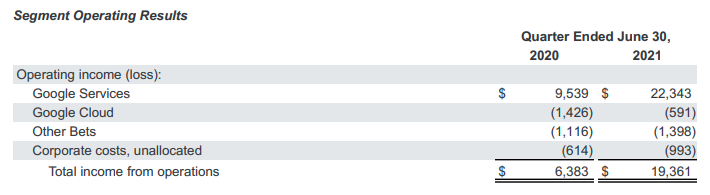
Image Credits: Alphabet

The real story, however, is in the epic gains that Alphabet posted in operating income from Q2 2020 to Q2 2021. Just look at that acceleration in operating income! It’s a somewhat befuddling result in terms of its quality.

What else to take note of? Google’s share repurchase program has been modified some, but not in a manner that should impact regular investors. So we can leave Alphabet’s quarter content that the company did well enough to defend its market cap of just over $1.75 trillion, even if it did not manage to add too much to the figure in after-hours trading thus far.

It’s a great time to be a huge tech company.

Comments

Popular posts from this blog

Uber co-founder Garrett Camp steps back from board director role

Uber co-founder Garrett Camp is relinquishing his role as a board director and switching to board observer — where he says he’ll focus on product strategy for the ride hailing giant. Camp made the announcement in a short Medium post in which he writes of his decade at Uber: “I’ve learned a lot, and realized that I’m most helpful when focused on product strategy & design, and this is where I’d like to focus going forward.” “I will continue to work with Dara [Khosrowshahi, Uber CEO] and the product and technology leadership teams to brainstorm new ideas, iterate on plans and designs, and continue to innovate at scale,” he adds. “We have a strong and diverse team in place, and I’m confident everyone will navigate well during these turbulent times.” The Canadian billionaire entrepreneur signs off by saying he’s looking forward to helping Uber “brainstorm the next big idea”. Camp hasn’t been short of ideas over his career in tech. He’s the co-founder of the web 2.0 recommendatio...

Leading VCs discuss how COVID-19 has impacted the world of digital health

In December 2019, Extra Crunch spoke to a group of investors leading the charge in health tech to discuss where they saw the most opportunity in the space leading into 2020 . At the time, respondents highlighted startups in digital therapeutics, telehealth and mental health that were improving medical practitioner efficiency or streamlining the distribution of care, amongst a variety of other digital health markets that were garnering the most attention. Where top VCs are investing in digital health In the months since, the COVID-19 crisis has debilitated national healthcare systems and the global economy. Weaknesses in healthcare systems have become clearer than ever, while startups and capital providers have struggled to operate while wide swaths of the market effectively shut down. Given significant volatility and the rapid changes seen in the worlds of healthcare, venture and startups broadly, we wanted to understand which inefficiencies might have been brought to light, w...

News-reading app Flipboard expands local coverage, including coronavirus updates, to 12 more U.S. metros

Earlier this year, personalized news aggregation app Flipboard expanded into local news . The feature brought local news, sports, real estate, weather, transportation news and more to 23 cities across the U.S. Today, Flipboard is bringing local news to 12 more U.S. metros and is adding critical coronavirus local coverage to all of the 35 supported locales. The 12 new metros include the following:  Baltimore, Charlotte, Cleveland, Detroit, Indianapolis, Nashville, Pittsburgh, Orlando, Raleigh, Salt Lake City, St. Louis, and Tampa Bay. They join the 23 cities that were already supported:  Atlanta, Austin, Boston, Chicago, Dallas, Denver, Houston, Las Vegas, Los Angeles, Miami, Minneapolis-St. Paul, New Orleans, New York City, Philadelphia, Phoenix, Portland, Sacramento, San Diego, San Francisco Bay Area, Seattle, Toronto, Vancouver and Washington, D.C. To offer local news in its app, Flipboard works with area partners, big and small, like The Plain Dealer’s Cleveland.com , ...