A new startup called Clay, backed by $8 million in seed funding, has built a system designed to help you be more thoughtful with the people in your life, which operates somewhat like a personal CRM. With Clay, you build a collection of the people you meet by connecting your email and calendar with social apps, including Twitter and LinkedIn. Clay then populates each person’s entry with all the relevant information you would need to recall for any future meeting — ranging from their work history to latest tweets to the details on how you met and when you last communicated, among other things.
You also can add notes of your own to each entry, click to activate reminders to follow up with certain people and organize entries into groups. The app supports a command bar, keyboard shortcuts and home screen widgets, as well.
The end result is something that’s not exactly an address book but also not necessarily as sales and pipeline-focused as a CRM system.
Clay’s founders instead refer to their app as a “home for your people,” as it’s attempting to carve out a new space in the market for a more personal system of tracking who you know and how.
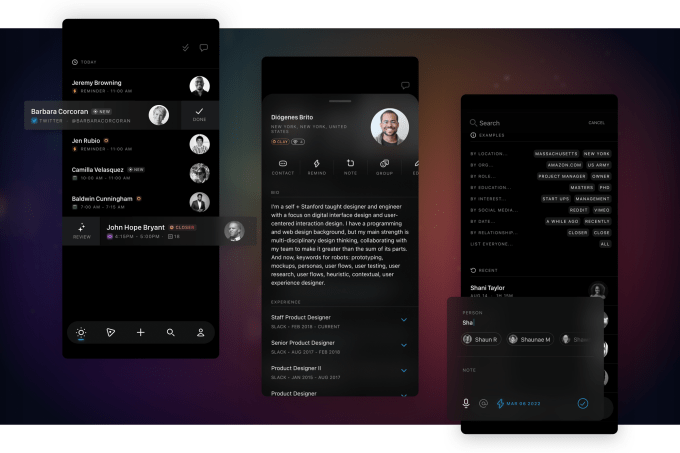
Image Credits: Clay
The idea for the startup comes from entrepreneurs Matthew Achariam and Zachary Hamed, Clay’s co-founders and co-CEOs, who met back in their early days of working with startups. Prior to starting Clay, Achariam helped lead product at Y Combinator-backed analytics company, Custora, and Hamed led the product management team for Goldman Sachs’ web platform, Marquee.
“We think that people and relationships have played such an important role in our own career trajectories. And we wanted to dive into that,” Hamed explains, when speaking about what prompted their interest in building Clay.
To get started with Clay — which is available as a web, desktop and mobile app — you’ll first connect your accounts. At present, Clay supports Microsoft Outlook/Office 365, Google Calendar, Gmail/Google Mail, and Twitter. You can also add other services via Zapier integrations. After setup, Clay will then automatically track your meetings and personal connections, and augment people’s entries with other details pulled from the web, like their background and work experience listed on LinkedIn and latest tweets.
People’s entries will also detail how you met the person — something people tend to forget over time. For example, they may be noted as a connection you made on LinkedIn, or someone you met in person or in an online meeting.
Through Clay’s desktop app, you can also optionally connect Clay with iMessage, which allows it to augment its people entries with phone numbers and details about when you last communicated. However, this feature should be met with some caution. While Clay doesn’t import the content of your messages, the company says, it has to work around the lack of an official API or SDK to perform this integration. That means the feature requires full disk access in order to function. That’s an elevated security permission some will not feel comfortable using.
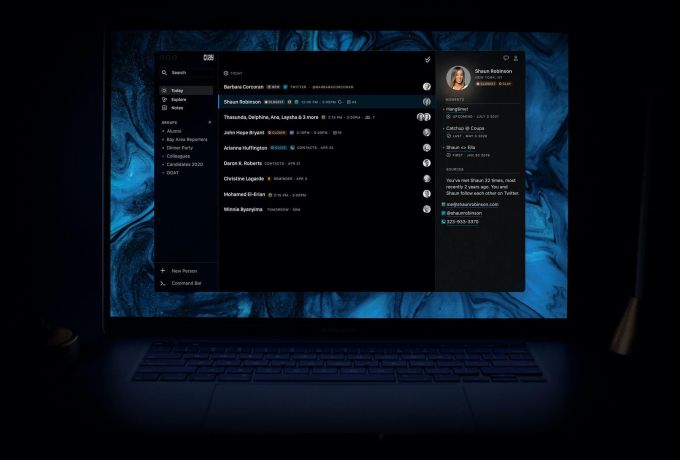
Image Credits: Clay
The founders, however, say they’ve built Clay to respect people’s privacy and security. The company’s privacy policy is human-readable and each integration is explained in terms of what data is pulled, what’s not pulled, and how the data is used. Currently, data is encrypted on Clay’s servers and in transit, but the goal — and part of what the funding round is going towards — is to make Clay work fully locally on users’ devices.
“We want it to work fully on your machine. We don’t want to be storing any data at all,” says Hamed. “To do that is a very technically complex task, so it was prohibitively out of reach for Matt and I as we were building Clay in the beginning. But now that we have resources, that is our eventual goal.”
Still, Clay may face a difficult time convincing users that it’s safe, due to how many times people have been burned in the past over “smart” address books that abused users’ private data. Only last year, a new startup in this space, Sunshine Contacts, was found to be distributing people’s home addresses, even though these people hadn’t signed up for the app. Many other prior efforts also failed because they overstepped user privacy concerns in order to generate revenue.
Achariam believes the problem with these earlier products was often the business model they adopted.
“That was one of the things we really were thinking about when we started going into the space — because we, ourselves, wanted something like this — and every product that we saw kind of rubbed us the wrong way or exploded because of those reasons,” notes Achariam, of the smart address market’s history. “A lot of these things started off with making the user the product. And then you weren’t paying for it. There was no sustainable business model and at some point, they had to balance those trade-offs,” he says.

Image Credits: Clay
Clay is doing things differently. It’s starting from day one with a pricing plan that will allow it to self-sustain. Right now, that’s a fairly steep $20 per month, but the goal is to bring that down over time and introduce a free plan. (It’s also offering cheaper access to certain groups, like students and non-profits, if a request is emailed.)
During testing, Clay was adopted by a number of different types of users, including teachers who wanted to remember students and their parents; a congressional candidate who wanted to track their constituents; and a veterinarian who wanted to remember customers and their pets.
“We intentionally made it really cross-industry, cross- disciplinary. We didn’t think that this was a tech problem or investor problem. We went broader,” notes Hamed.
The startup has raised a total of $8 million in seed funding from 2019 through 2020. The funding was led by Forerunner Ventures, with participation from General Catalyst.
Angel investors include Shannon Brayton, former CMO at LinkedIn; Kevin Hartz, former CEO of Eventbrite; Kelvin Beachum, an NFL player, philanthropist, and investor; Lindsay Kaplan, co-founder of Chief and former VP of Communications and Brand at Casper; Zoelle Egner, former marketing lead at Airtable; Adam Evans, former CTO of RelateIQ; Charlie Songhurst, former head of corporate strategy at Microsoft; Sam Lessin, former VP of product management at Facebook; Jonah Goodhart, former CEO of Moat and SVP at Oracle; Jeff Morris Jr., Chapter One Ventures, and others.
“Emerging from COVID, people are recognizing what had already become true. Relationships are increasingly digital, formed through online interaction and honed through messaging apps. So, how is it that we can be continuously connected, yet increasingly lonely at the same time?” stated Forerunner GP Brian O’Malley, about his firm’s investment. “The problem is that existing social products don’t serve you as the end user. You are just a pawn for some other customer, like a recruiter or some unknown advertiser. Clay is the first relationship software company built to understand all the signals that drive your connections, helping you form better ones with a broader set of people. Clay understands that your network is yours, so you should be empowered to own it,” he added.
Clay is currently opened to sign-ups through its website.


Comments
Post a Comment