https://www.highperformancecpmgate.com/rgeesizw1?key=a9d7b2ab045c91688419e8e18a006621

Google Maps adds ability to see speed limits and speed traps in 40+ countries

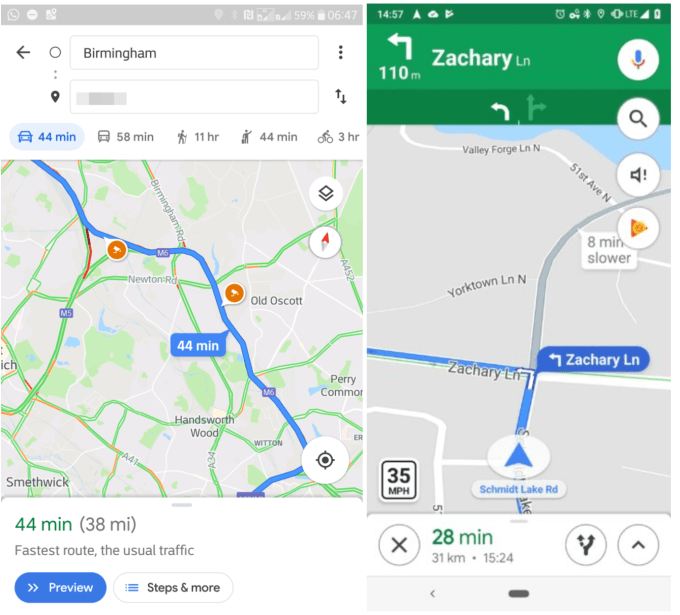
Google Maps is gaining some features previously exclusive to Google’s navigation app, Waze. The company confirmed it’s rolling out the ability for Google Maps users to see speed limits, speed cameras and mobile speed cameras in more than 40 countries worldwide — an expansion of its earlier launch of these features, which were previously limited to select markets.

The change was noted earlier by ZDNet and, of course, Reddit.

Google confirmed with TechCrunch the full list of supported countries now seeing the speed cameras, which currently includes: Australia, Brazil, U.S., Canada, U.K., India, Mexico, Russia, Japan, Andorra, Bosnia and Herzegovina, Bulgaria, Croatia, Czechia, Estonia, Finland, Greece, Hungary, Iceland, Israel, Italy, Jordan, Kuwait, Latvia, Lithuania, Malta, Morocco, Namibia, Netherlands, Norway, Oman, Poland, Portugal, Qatar, Romania, Saudi Arabia, Serbia, Slovakia, South Africa, Spain, Sweden, Tunisia, and Zimbabwe.

Google had not been quick to integrate Waze’s best features into its own Google Maps app, following its 2013 acquisition of the popular navigation app. Instead, it seems to prefer using Google Maps as a broader platform for helping people find places including — most importantly — nearby businesses and Google advertisers.
Above: Image credit – Android Police

But last year, some people began to spot incident reports as well as crash and speed trap reports appearing in Google Maps. Those features were not broadly rolled out to all users at that time, however.

Now, that’s starting to change.

Google began to roll out the ability for users in more countries to see speed cameras around two weeks ago, we understand. The rollout is taking place on both Android and iOS. But Android users will additionally be able to report mobile speed cameras and stationary cameras, while both iOS and Android users will be able to see those updates during their drive.

The speed limit appears in the bottom corner of the app, while speed traps show up as icons on the roads themselves.

The features will likely appeal to users who want similar functionality as to what’s available today in Waze, but don’t either care for the Waze user interface (which can be overwhelming if you’re not used to it), or the way Waze chooses its routes.

There has been some confusion over where and when these alerts would be available, as Google failed to officially announce the features’ expansion. Adding to the confusion was the fact that people were seeing the changes appear at different stages of the rollout in different countries around the world.

Despite the usefulness of speed-related alerts, Waze remains the more useful navigation platform due to its ability to crowdsource reports of all kinds — including police ahead, crashes, cars pulled over on the side of the road, gas prices, road closures, obstacles in your path like debris, red light cameras and more.

We understand Google Maps uses a combination of authoritative feeds along with feedback from Google Maps users in order to locate the speed cameras.

Comments

Popular posts from this blog

Uber co-founder Garrett Camp steps back from board director role

Uber co-founder Garrett Camp is relinquishing his role as a board director and switching to board observer — where he says he’ll focus on product strategy for the ride hailing giant. Camp made the announcement in a short Medium post in which he writes of his decade at Uber: “I’ve learned a lot, and realized that I’m most helpful when focused on product strategy & design, and this is where I’d like to focus going forward.” “I will continue to work with Dara [Khosrowshahi, Uber CEO] and the product and technology leadership teams to brainstorm new ideas, iterate on plans and designs, and continue to innovate at scale,” he adds. “We have a strong and diverse team in place, and I’m confident everyone will navigate well during these turbulent times.” The Canadian billionaire entrepreneur signs off by saying he’s looking forward to helping Uber “brainstorm the next big idea”. Camp hasn’t been short of ideas over his career in tech. He’s the co-founder of the web 2.0 recommendatio...

How the world’s largest cannabis dispensary avoids social media restrictions

Planet 13 is the world’s largest cannabis dispensary. Located in Las Vegas, blocks off the Strip, the facility is the size of a small Walmart. By design, it’s hard to miss. Planet 13 is upending the dispensary model. It’s big, loud and visitors are encouraged to photograph everything. As part of the cannabis industry, Planet 13 is heavily restricted on the type of content it can publish on Instagram, Facebook and other social media platforms. It’s not allowed to post pictures of buds or vapes on some sites. It can’t talk about pricing or product selection on others.   View this post on Instagram   A post shared by Morgan Celeste SF Blogger (@bayareabeautyblogger) on Jan 25, 2020 at 7:54pm PST Instead, Planet 13 encourages its thousands of visitors to take photos and videos. Starting with the entrance, the facility is full of surprises tailored for the ‘gram. As a business, Planet 13’s social media content is heavily restricted a...

Leading VCs discuss how COVID-19 has impacted the world of digital health

In December 2019, Extra Crunch spoke to a group of investors leading the charge in health tech to discuss where they saw the most opportunity in the space leading into 2020 . At the time, respondents highlighted startups in digital therapeutics, telehealth and mental health that were improving medical practitioner efficiency or streamlining the distribution of care, amongst a variety of other digital health markets that were garnering the most attention. Where top VCs are investing in digital health In the months since, the COVID-19 crisis has debilitated national healthcare systems and the global economy. Weaknesses in healthcare systems have become clearer than ever, while startups and capital providers have struggled to operate while wide swaths of the market effectively shut down. Given significant volatility and the rapid changes seen in the worlds of healthcare, venture and startups broadly, we wanted to understand which inefficiencies might have been brought to light, w...