https://www.highperformancecpmgate.com/rgeesizw1?key=a9d7b2ab045c91688419e8e18a006621

Iconic font company Monotype is getting acquired by PE firm HGGC for $825M

A new chapter is opening up for Monotype, the font and imaging technology specialist that is associated with some of the more iconic evolutions in typefaces in the digital age (if you know Times New Roman or Arial, you know Monotype). Today, the company announced that private equity house HGGC is acquiring it for $825 million in an all-cash deal.

HGGC will be paying $19.85 per share for the company, effectively taking it private: Monotype has been around since 1887 and more recently traded on Nasdaq under the ticker “TYPE.” (The sale price represents a significant premium on the stock’s closing price yesterday of $16.16.) The deal has already been approved by the company’s board of directors and is expected to close in Q4 of this year.

The deal caps off a period of the company working to update and expand its focus beyond that of typeface technology — an area where it established itself as a leader in the pre-digital era but continued to play a role with the growth of digital fonts, with partnerships with the likes of Microsoft (licensing fonts for operating systems), and building new font libraries for a globalised internet (such as a collaboration with Google called the Noto Project, designed to build a font that would work across 800 languages and 100 writing scripts).

That expansion notably took Monotype from typefaces to images — a key and prescient evolution considering the use of emojis today replacing words. The company in the last four years made a number of acquisitions to that end, including Olapic and Swyft Media.

And after a prolonged and overall declining trajectory, now it’s the one getting acquired,

“Over the last several years, Monotype has strategically shifted its business from primarily serving a small group of OEM manufacturers to one that addresses the needs of thousands of brands and millions of creative professionals worldwide,” said Scott Landers, President and Chief Executive Officer, in a statement. “As a private company, we will have the financial support and added flexibility to invest in ways that deliver more value and improve the overall experience for our customers. This transaction is a testament to our talented employees and their dedication to serving our customers, and we look forward to partnering with HGGC as we continue helping customers maximize their customer engagement in today’s digital, mobile and global landscape.”

Indeed, Monotype is still best known for fonts, and you can go to its site to buy and experiment with new ones, or work with Monotype to create your own.
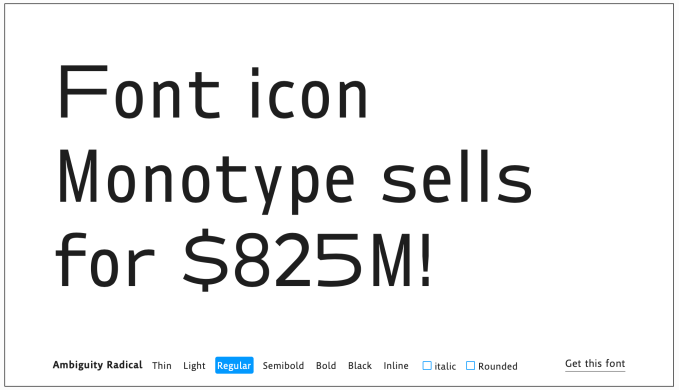
Screenshot 2019 07 26 at 13.23.29

Under the wing of the PE firm, the company — which has been modestly profitable, with results also reported today showing net income of $10.3 million on revenues of $63.2 million — is likely to get more investment, less scrutiny under the unrelenting eye of the public markets, and possibly some reorganization for whatever comes next.

“We have been impressed with the quality and expertise of the Monotype team led by Scott, whose relentless commitment to customers has helped brands realize their full identity and express it to the world,” said Rich Lawson, CEO and Co-Founder at HGGC, in a statement. “We look forward to working together to help advance Monotype’s strategy and continue delivering the products and services that allow for brand expression and differentiation.”

Comments

Popular posts from this blog

Uber co-founder Garrett Camp steps back from board director role

Uber co-founder Garrett Camp is relinquishing his role as a board director and switching to board observer — where he says he’ll focus on product strategy for the ride hailing giant. Camp made the announcement in a short Medium post in which he writes of his decade at Uber: “I’ve learned a lot, and realized that I’m most helpful when focused on product strategy & design, and this is where I’d like to focus going forward.” “I will continue to work with Dara [Khosrowshahi, Uber CEO] and the product and technology leadership teams to brainstorm new ideas, iterate on plans and designs, and continue to innovate at scale,” he adds. “We have a strong and diverse team in place, and I’m confident everyone will navigate well during these turbulent times.” The Canadian billionaire entrepreneur signs off by saying he’s looking forward to helping Uber “brainstorm the next big idea”. Camp hasn’t been short of ideas over his career in tech. He’s the co-founder of the web 2.0 recommendatio...

How the world’s largest cannabis dispensary avoids social media restrictions

Planet 13 is the world’s largest cannabis dispensary. Located in Las Vegas, blocks off the Strip, the facility is the size of a small Walmart. By design, it’s hard to miss. Planet 13 is upending the dispensary model. It’s big, loud and visitors are encouraged to photograph everything. As part of the cannabis industry, Planet 13 is heavily restricted on the type of content it can publish on Instagram, Facebook and other social media platforms. It’s not allowed to post pictures of buds or vapes on some sites. It can’t talk about pricing or product selection on others.   View this post on Instagram   A post shared by Morgan Celeste SF Blogger (@bayareabeautyblogger) on Jan 25, 2020 at 7:54pm PST Instead, Planet 13 encourages its thousands of visitors to take photos and videos. Starting with the entrance, the facility is full of surprises tailored for the ‘gram. As a business, Planet 13’s social media content is heavily restricted a...

Billionaire clothing dynasty heiress launches Everybody & Everyone to make fashion sustainable

Veronica Chou’s family has made its fortune at the forefront of the fast fashion business through investments in companies like Michael Kors and Tommy Hilfiger . But now, the heiress to an estimated $2.1 billion fortune is launching her own company, Everybody & Everyone , to prove that the fashion industry can be both environmentally sustainable and profitable. There’s no argument about the negative impacts of the fashion industry on the environment. The textiles industry primarily uses non-renewable resources — on the order of 98 million tons per year. That includes the oil to make synthetic fibers, fertilizers to grow cotton, and toxic chemicals to dye, treat, and produce the textiles used to make clothes. The greenhouse gas footprint from textiles production was roughly 1.2 billion tons of CO2 equivalent in 2015 — more than all international flights and maritime shipments combined (and a lot of those maritime shipments and international flights were hauling clothes). The lit...