https://www.highperformancecpmgate.com/rgeesizw1?key=a9d7b2ab045c91688419e8e18a006621

TaskRabbit is resetting customer passwords after finding ‘suspicious activity’ on its network

TaskRabbit has reset an unknown number of customer passwords after confirming it detected “suspicious activity” on its network.

The IKEA-owned online marketplace for on-demand labor said it reset user passwords out of an abundance of caution and that it “took steps to prevent access to any user accounts,” a TaskRabbit spokesperson told TechCrunch.

The company later confirmed it was a credential stuffing attack, where existing sets of exposed or breached usernames and passwords are matched against different websites to access accounts.

“We acted in an abundance of caution and reset passwords for many TaskRabbit accounts, including all users who had not logged in since May 1, 2020, as well as all users who logged in during the time period of the attack, even though most of the latter activity was attributable to users’ regular use of our services,” the spokesperson said.

“As always, the safety and security of the TaskRabbit community is our priority, and we will continue to be vigilant about protecting our users’ personal information,” said the spokesperson.

TaskRabbit customers were alerted to the incident in a vague email that only noted their password had been recently changed “as a security precaution,” without saying what specifically prompted the account change. TechCrunch confirmed that the email was legitimate.
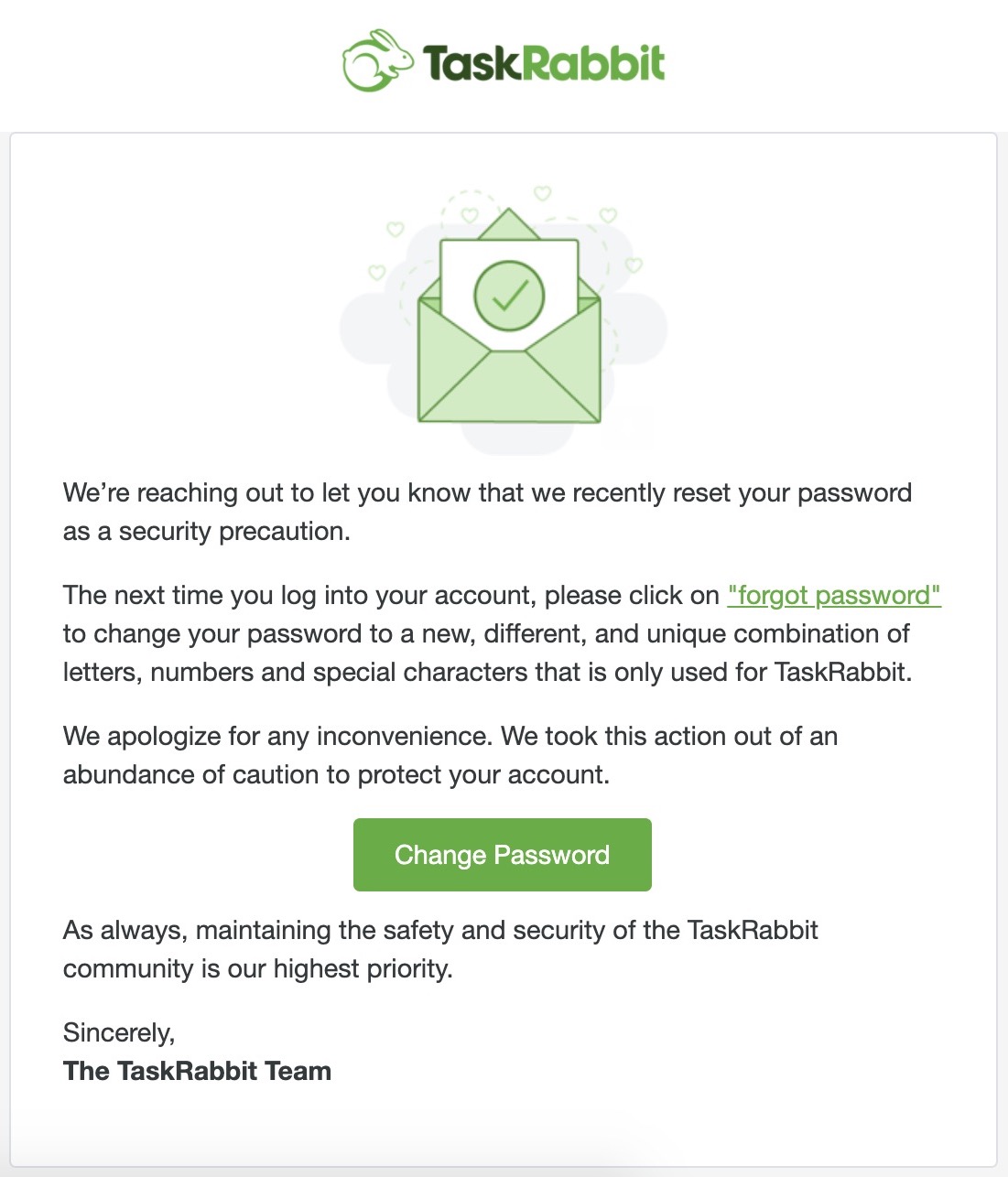
The password reset email sent to TaskRabbit customers. (Image: Sarah Perez/TechCrunch)

It’s not uncommon for companies to reset passwords after a security incident where customer or account information is accessed or stolen in a breach.

Last year, online apparel marketplace StockX reset customer passwords after initially citing “system updates,” but later admitted it took action after it found suspicious activity on its network. Days later, a hacker provided TechCrunch with 6.8 million StockX account records stolen from the company’s servers.

TaskRabbit’s freelance labor marketplace was founded in 2008, and grew over time from an auction-style platform for negotiating tasks and errands to a more mature and tailored marketplace to match customers with contractors. That eventually attracted the attention of furniture retailer IKEA, which bought the startup in September 2017 after TaskRabbit put itself on the market for a strategic buyer.

The year after the acquisition, however, TaskRabbit had to take its website and app down due to a “cybersecurity incident.” The company later revealed an attacker had gained unauthorized access to its systems. Then-TaskRabbit CEO Stacy Brown-Philpot said the company had contracted with an outside forensics team to identify what customer information had been compromised by the attack, and urged both users and providers to stay vigilant in monitoring their own accounts for suspicious activity.

Following the attack, the company said it was implementing several new security measures and would work on making the log-in process more secure. It also said it would reduce the amount of data retained about taskers and customers as well as “enhance overall network cyber threat detection technology.”

Brown-Philpot left TaskRabbit earlier this year, and the CEO role has since been filled by former Airbnb and Uber Eats leader, Ania Smith.

Updated with additional comment from TaskRabbit.

Comments

Popular posts from this blog

Uber co-founder Garrett Camp steps back from board director role

Uber co-founder Garrett Camp is relinquishing his role as a board director and switching to board observer — where he says he’ll focus on product strategy for the ride hailing giant. Camp made the announcement in a short Medium post in which he writes of his decade at Uber: “I’ve learned a lot, and realized that I’m most helpful when focused on product strategy & design, and this is where I’d like to focus going forward.” “I will continue to work with Dara [Khosrowshahi, Uber CEO] and the product and technology leadership teams to brainstorm new ideas, iterate on plans and designs, and continue to innovate at scale,” he adds. “We have a strong and diverse team in place, and I’m confident everyone will navigate well during these turbulent times.” The Canadian billionaire entrepreneur signs off by saying he’s looking forward to helping Uber “brainstorm the next big idea”. Camp hasn’t been short of ideas over his career in tech. He’s the co-founder of the web 2.0 recommendatio...

How the world’s largest cannabis dispensary avoids social media restrictions

Planet 13 is the world’s largest cannabis dispensary. Located in Las Vegas, blocks off the Strip, the facility is the size of a small Walmart. By design, it’s hard to miss. Planet 13 is upending the dispensary model. It’s big, loud and visitors are encouraged to photograph everything. As part of the cannabis industry, Planet 13 is heavily restricted on the type of content it can publish on Instagram, Facebook and other social media platforms. It’s not allowed to post pictures of buds or vapes on some sites. It can’t talk about pricing or product selection on others.   View this post on Instagram   A post shared by Morgan Celeste SF Blogger (@bayareabeautyblogger) on Jan 25, 2020 at 7:54pm PST Instead, Planet 13 encourages its thousands of visitors to take photos and videos. Starting with the entrance, the facility is full of surprises tailored for the ‘gram. As a business, Planet 13’s social media content is heavily restricted a...

Billionaire clothing dynasty heiress launches Everybody & Everyone to make fashion sustainable

Veronica Chou’s family has made its fortune at the forefront of the fast fashion business through investments in companies like Michael Kors and Tommy Hilfiger . But now, the heiress to an estimated $2.1 billion fortune is launching her own company, Everybody & Everyone , to prove that the fashion industry can be both environmentally sustainable and profitable. There’s no argument about the negative impacts of the fashion industry on the environment. The textiles industry primarily uses non-renewable resources — on the order of 98 million tons per year. That includes the oil to make synthetic fibers, fertilizers to grow cotton, and toxic chemicals to dye, treat, and produce the textiles used to make clothes. The greenhouse gas footprint from textiles production was roughly 1.2 billion tons of CO2 equivalent in 2015 — more than all international flights and maritime shipments combined (and a lot of those maritime shipments and international flights were hauling clothes). The lit...