https://www.highperformancecpmgate.com/rgeesizw1?key=a9d7b2ab045c91688419e8e18a006621

Disney+ adds a co-watching feature called GroupWatch

Disney+ is the latest streaming service to introduce a way for friends and family to watch movies and TV together while in different locations.

With the pandemic closing movie theaters and making any kind of indoor socializing pretty risky, the Netflix Party Chrome extension has become the main way I watch TV with friends. Netflix Party doesn’t have any official connection to Netflix, but other streaming services, like Amazon Prime Video and Disney-owned Hulu, have been adding similar features of their own.

Disney has already been testing the new GroupWatch feature in Canada, Australia and New Zealand, and today it’s launching for viewers in the United States.

Jerrell Jimerson, the chief product officer for Disney’s streaming services, told me that GroupWatch was already in development before the pandemic, but that the company “worked to accelerate it given the realities of COVID.”

The Disney+ experience has some key advantages over most other co-watching technology, because it doesn’t require users to install a browser extension and it will work on any device, not just laptop and desktop computers. Jimerson explained that the goal was to create something that was “super easy for consumers to use” and that “didn’t take away from the content and didn’t take away from the viewing experience.”
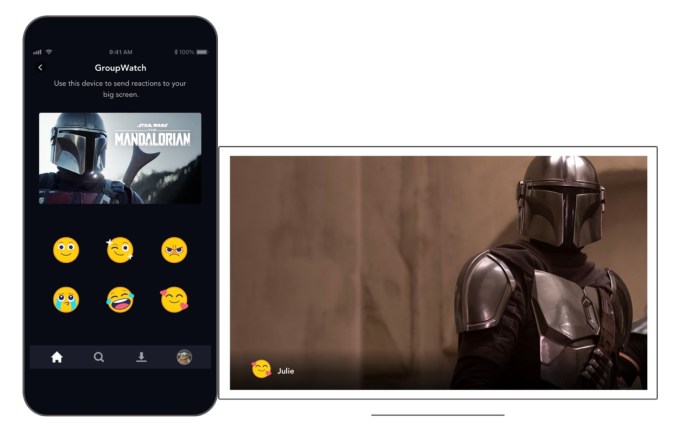
Disney+ GroupWatch

Image Credits: Disney

Once you’ve selected GroupWatch from the Details menu of a movie or TV show, you can invite up to six other people to participate — of course, they’ll need a Disney+ subscription of their own. And while the invitation has to be created via the Disney+ website or mobile app, people can also participate in a GroupWatch from their internet-connected TVs.

Besides synchronizing video playback (which any participant can control), GroupWatch allows viewers to respond to what’s happening on-screen by sharing emojis. But it lacks one of the hallmarks of co-watching, namely a chat that runs alongside the video.

Granted, a chat window could have been a bit distracting when blown up onto a big TV, but it’s arguably the centerpiece of social viewing. Jimerson said that if viewers want to chat, they can continue talking on whatever channel they used to send the invite (presumably a chat app on their phones).

“There are other opportunities to integrate communication capabilities, but we haven’t shared any timing on those things,” he added.

Comments

Popular posts from this blog

Uber co-founder Garrett Camp steps back from board director role

Uber co-founder Garrett Camp is relinquishing his role as a board director and switching to board observer — where he says he’ll focus on product strategy for the ride hailing giant. Camp made the announcement in a short Medium post in which he writes of his decade at Uber: “I’ve learned a lot, and realized that I’m most helpful when focused on product strategy & design, and this is where I’d like to focus going forward.” “I will continue to work with Dara [Khosrowshahi, Uber CEO] and the product and technology leadership teams to brainstorm new ideas, iterate on plans and designs, and continue to innovate at scale,” he adds. “We have a strong and diverse team in place, and I’m confident everyone will navigate well during these turbulent times.” The Canadian billionaire entrepreneur signs off by saying he’s looking forward to helping Uber “brainstorm the next big idea”. Camp hasn’t been short of ideas over his career in tech. He’s the co-founder of the web 2.0 recommendatio...

Leading VCs discuss how COVID-19 has impacted the world of digital health

In December 2019, Extra Crunch spoke to a group of investors leading the charge in health tech to discuss where they saw the most opportunity in the space leading into 2020 . At the time, respondents highlighted startups in digital therapeutics, telehealth and mental health that were improving medical practitioner efficiency or streamlining the distribution of care, amongst a variety of other digital health markets that were garnering the most attention. Where top VCs are investing in digital health In the months since, the COVID-19 crisis has debilitated national healthcare systems and the global economy. Weaknesses in healthcare systems have become clearer than ever, while startups and capital providers have struggled to operate while wide swaths of the market effectively shut down. Given significant volatility and the rapid changes seen in the worlds of healthcare, venture and startups broadly, we wanted to understand which inefficiencies might have been brought to light, w...

News-reading app Flipboard expands local coverage, including coronavirus updates, to 12 more U.S. metros

Earlier this year, personalized news aggregation app Flipboard expanded into local news . The feature brought local news, sports, real estate, weather, transportation news and more to 23 cities across the U.S. Today, Flipboard is bringing local news to 12 more U.S. metros and is adding critical coronavirus local coverage to all of the 35 supported locales. The 12 new metros include the following:  Baltimore, Charlotte, Cleveland, Detroit, Indianapolis, Nashville, Pittsburgh, Orlando, Raleigh, Salt Lake City, St. Louis, and Tampa Bay. They join the 23 cities that were already supported:  Atlanta, Austin, Boston, Chicago, Dallas, Denver, Houston, Las Vegas, Los Angeles, Miami, Minneapolis-St. Paul, New Orleans, New York City, Philadelphia, Phoenix, Portland, Sacramento, San Diego, San Francisco Bay Area, Seattle, Toronto, Vancouver and Washington, D.C. To offer local news in its app, Flipboard works with area partners, big and small, like The Plain Dealer’s Cleveland.com , ...