https://www.highperformancecpmgate.com/rgeesizw1?key=a9d7b2ab045c91688419e8e18a006621

Walmart’s AI is getting smarter about grocery delivery

It’s no surprise that the coronavirus pandemic has changed the way we shop, especially when it comes to groceries. Grocery delivery apps experienced a record number of downloads in March 2020, and by the following month, Walmart Grocery (which is now integrated into the Walmart app) surpassed Amazon as the No. 1 shopping app on both Google Play and the App Store. But even as pandemic restrictions have eased, consumers are still using ordering groceries for delivery or pickup more frequently than they were pre-pandemic.

As Walmart’s grocery delivery services have continued to boom, posing competition to companies like Amazon and Instacart, the tech that Walmart uses has expanded too. Today, Walmart shared information about how it’s training its AI to make smarter substitutions in online grocery orders.

Bringing this technology to grocery delivery isn’t novel by any means. Last May, Walmart reported how it used to AI to determine eligibility for its Express delivery service, which was brand new at the time. A year into the United States’ coronavirus outbreak, Instacart engineers reported that they crunched “petabytes daily to predict what will be on grocery shelves and even how long it will take to find parking.”

So what makes Walmart’s AI for grocery substitutions unique? According to Srini Venkatesan, an Executive Vice President at Walmart Global Tech, it’s the sheer quantity of data that Walmart can use to teach its AI. Over 200 million people shop at Walmart in-store and online each week for more than 150,000 different grocery products. The AI uses that data to predict consumer behavior, preferences, and needs.

“The tech we built uses deep learning AI to consider hundreds of variables — size, type, brand, price, aggregate shopper data, individual customer preference, current inventory and more — in real time to determine the best next available item,” explained Venkatesan. “It then preemptively asks the customer to approve the substituted item or let us know they don’t want it, an important signal that’s fed back into our learning algorithms to improve the accuracy of future recommendations.”
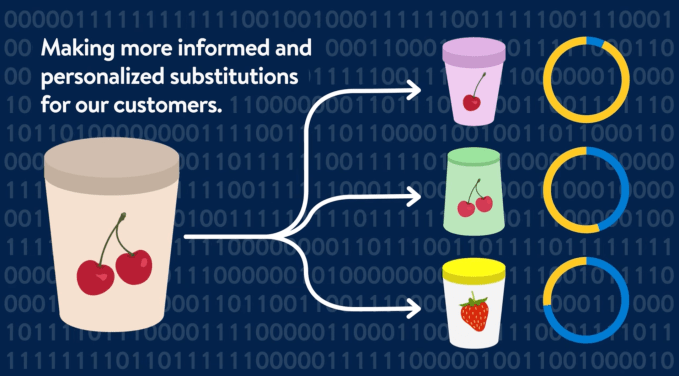
Image Credits: Walmart

Rather than asking a Personal Shopper to make a quick decision about how to substitute for cherry yogurt (do you get a different flavor from the same brand, the same flavor from a more expensive brand, and so on), the AI makes that choice for them. Walmart started developing this algorithm last year, and in the time since, customer acceptance of substitutions has improved.

“We were at about 90% before this algorithm rolled out,” said Venkatesan. “We are now around 97% to 98%.”

In the last year, Walmart doubled its number of Personal Shoppers to over 170,000 workers. About 3,750 stores are enabled for order pickup, and 3,000 stores are enabled for delivery, which covers 68% of the population. Earlier this year, Walmart dropped the $35 order minimum on its Express delivery service, a competitor to Amazon’s Prime Now.

Comments

Popular posts from this blog

Uber co-founder Garrett Camp steps back from board director role

Uber co-founder Garrett Camp is relinquishing his role as a board director and switching to board observer — where he says he’ll focus on product strategy for the ride hailing giant. Camp made the announcement in a short Medium post in which he writes of his decade at Uber: “I’ve learned a lot, and realized that I’m most helpful when focused on product strategy & design, and this is where I’d like to focus going forward.” “I will continue to work with Dara [Khosrowshahi, Uber CEO] and the product and technology leadership teams to brainstorm new ideas, iterate on plans and designs, and continue to innovate at scale,” he adds. “We have a strong and diverse team in place, and I’m confident everyone will navigate well during these turbulent times.” The Canadian billionaire entrepreneur signs off by saying he’s looking forward to helping Uber “brainstorm the next big idea”. Camp hasn’t been short of ideas over his career in tech. He’s the co-founder of the web 2.0 recommendatio...

How the world’s largest cannabis dispensary avoids social media restrictions

Planet 13 is the world’s largest cannabis dispensary. Located in Las Vegas, blocks off the Strip, the facility is the size of a small Walmart. By design, it’s hard to miss. Planet 13 is upending the dispensary model. It’s big, loud and visitors are encouraged to photograph everything. As part of the cannabis industry, Planet 13 is heavily restricted on the type of content it can publish on Instagram, Facebook and other social media platforms. It’s not allowed to post pictures of buds or vapes on some sites. It can’t talk about pricing or product selection on others.   View this post on Instagram   A post shared by Morgan Celeste SF Blogger (@bayareabeautyblogger) on Jan 25, 2020 at 7:54pm PST Instead, Planet 13 encourages its thousands of visitors to take photos and videos. Starting with the entrance, the facility is full of surprises tailored for the ‘gram. As a business, Planet 13’s social media content is heavily restricted a...

Billionaire clothing dynasty heiress launches Everybody & Everyone to make fashion sustainable

Veronica Chou’s family has made its fortune at the forefront of the fast fashion business through investments in companies like Michael Kors and Tommy Hilfiger . But now, the heiress to an estimated $2.1 billion fortune is launching her own company, Everybody & Everyone , to prove that the fashion industry can be both environmentally sustainable and profitable. There’s no argument about the negative impacts of the fashion industry on the environment. The textiles industry primarily uses non-renewable resources — on the order of 98 million tons per year. That includes the oil to make synthetic fibers, fertilizers to grow cotton, and toxic chemicals to dye, treat, and produce the textiles used to make clothes. The greenhouse gas footprint from textiles production was roughly 1.2 billion tons of CO2 equivalent in 2015 — more than all international flights and maritime shipments combined (and a lot of those maritime shipments and international flights were hauling clothes). The lit...