https://www.highperformancecpmgate.com/rgeesizw1?key=a9d7b2ab045c91688419e8e18a006621

Bzaar bags $4M to enable US retailers to source home, lifestyle products from India

Small businesses in the U.S. now have a new way to source home and lifestyle goods from new manufacturers. Bzaar, a business-to-business cross-border marketplace, is connecting retailers with over 50 export-ready manufacturers in India.

The U.S.-based company announced Monday that it raised $4 million in seed funding, led by Canaan Partners, and including angel investors Flipkart co-founder Binny Bansal, PhonePe founders Sameer Nigam and Rahul Chari, Addition founder Lee Fixel and Helion Ventures co-founder Ashish Gupta.

Nishant Verman and Prasanth Nair co-founded Bzaar in 2020 and consider their company to be like a “fair without borders,” Verman put it. Prior to founding Bzaar, Verman was at Bangalore-based Flipkart until it was acquired by Walmart in 2018. He then was at Canaan Partners in the U.S.

“We think the next 10 years of global trade will be different from the last 100 years,” he added. “That’s why we think this business needs to exist.”

Traditionally, small U.S. buyers did not have feet on the ground in manufacturing hubs, like China, to manage shipments of goods in the same way that large retailers did. Then Alibaba came along in the late 1990s and began acting as a gatekeeper for cross-border purchases, Verman said. U.S. goods imports from China totaled $451.7 billion in 2019, while U.S. goods imports from India in 2019 were $87.4 billion.
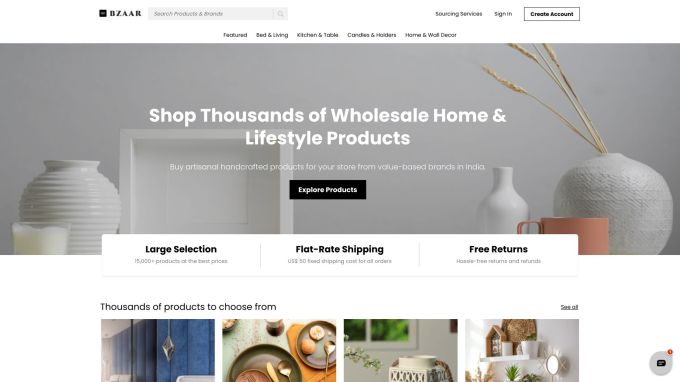
Bzaar screenshot. Image Credits: Bzaar

Small buyers could buy home and lifestyle goods, but it was typically through the same sellers, and there was not often a unique selection, nor were goods available handmade or using organic materials, he added.

With Bzaar, small buyers can purchase over 10,000 wholesale goods on its marketplace from other countries like India and Southeast Asia. The company guarantees products arrive within two weeks and manage all of the packaging logistics and buyer protection.

Verman and Nair launched the marketplace in April and had thousands users in three continents purchasing from the platform within six months. Meanwhile, products on Bzaar are up to 50% cheaper than domestic U.S. platforms, while SKU selection is growing doubling every month, Verman said.

The new funding will enable the company to invest in marketing to get in front of buyers and invest on its technology to advance its cataloging feature so that goods pass through customs seamlessly. Wanting to provide new features for its small business customers, Verman also intends to create a credit feature to enable buyers to pay in installments or up to 90 days later.

“We feel this is a once-in-a-lifetime shift in how global trade works,” he added. “You need the right team in place to do this because the problem is quite complex to take products from a small town in Vietnam to Nashville. With our infrastructure in place, the good news is there are already shops and buyers, and we are stitching them together to give buyers a seamless experience.”


Comments

Popular posts from this blog

Uber co-founder Garrett Camp steps back from board director role

Uber co-founder Garrett Camp is relinquishing his role as a board director and switching to board observer — where he says he’ll focus on product strategy for the ride hailing giant. Camp made the announcement in a short Medium post in which he writes of his decade at Uber: “I’ve learned a lot, and realized that I’m most helpful when focused on product strategy & design, and this is where I’d like to focus going forward.” “I will continue to work with Dara [Khosrowshahi, Uber CEO] and the product and technology leadership teams to brainstorm new ideas, iterate on plans and designs, and continue to innovate at scale,” he adds. “We have a strong and diverse team in place, and I’m confident everyone will navigate well during these turbulent times.” The Canadian billionaire entrepreneur signs off by saying he’s looking forward to helping Uber “brainstorm the next big idea”. Camp hasn’t been short of ideas over his career in tech. He’s the co-founder of the web 2.0 recommendatio...

How the world’s largest cannabis dispensary avoids social media restrictions

Planet 13 is the world’s largest cannabis dispensary. Located in Las Vegas, blocks off the Strip, the facility is the size of a small Walmart. By design, it’s hard to miss. Planet 13 is upending the dispensary model. It’s big, loud and visitors are encouraged to photograph everything. As part of the cannabis industry, Planet 13 is heavily restricted on the type of content it can publish on Instagram, Facebook and other social media platforms. It’s not allowed to post pictures of buds or vapes on some sites. It can’t talk about pricing or product selection on others.   View this post on Instagram   A post shared by Morgan Celeste SF Blogger (@bayareabeautyblogger) on Jan 25, 2020 at 7:54pm PST Instead, Planet 13 encourages its thousands of visitors to take photos and videos. Starting with the entrance, the facility is full of surprises tailored for the ‘gram. As a business, Planet 13’s social media content is heavily restricted a...

Billionaire clothing dynasty heiress launches Everybody & Everyone to make fashion sustainable

Veronica Chou’s family has made its fortune at the forefront of the fast fashion business through investments in companies like Michael Kors and Tommy Hilfiger . But now, the heiress to an estimated $2.1 billion fortune is launching her own company, Everybody & Everyone , to prove that the fashion industry can be both environmentally sustainable and profitable. There’s no argument about the negative impacts of the fashion industry on the environment. The textiles industry primarily uses non-renewable resources — on the order of 98 million tons per year. That includes the oil to make synthetic fibers, fertilizers to grow cotton, and toxic chemicals to dye, treat, and produce the textiles used to make clothes. The greenhouse gas footprint from textiles production was roughly 1.2 billion tons of CO2 equivalent in 2015 — more than all international flights and maritime shipments combined (and a lot of those maritime shipments and international flights were hauling clothes). The lit...