https://www.highperformancecpmgate.com/rgeesizw1?key=a9d7b2ab045c91688419e8e18a006621

Carry1st has $4M to invest in African mobile gaming

Gaming development startup Carry1st has raised a $2.5 million seed round led by CRE Venture Capital.

That brings the company’s total VC to $4 million, which Carry1st will deploy to support and invest in game publishing across Africa.

The startup — with offices in New York, Lagos, and South Africa — was co-founded in 2018 by Sierra Leonean Cordel Robbin-Coker, American Lucy Parry, and Zimbabwean software engineer Tinotenda Mundangepfupfu.

Robbin-Coker and Parry met while working in investment banking in New York, before forming Carry1st.

“I convinced her to avoid going to business school and instead come to South Africa to Cape Town,” Robbin-Coker told TechCrunch on a call.

“We launched with the idea that we wanted to bring the gaming industry…to the African continent.”

Carry1st looks to match gaming demand in Africa to the continent’s fast growing youth population, improving internet penetration and rapid smartphone adoption.

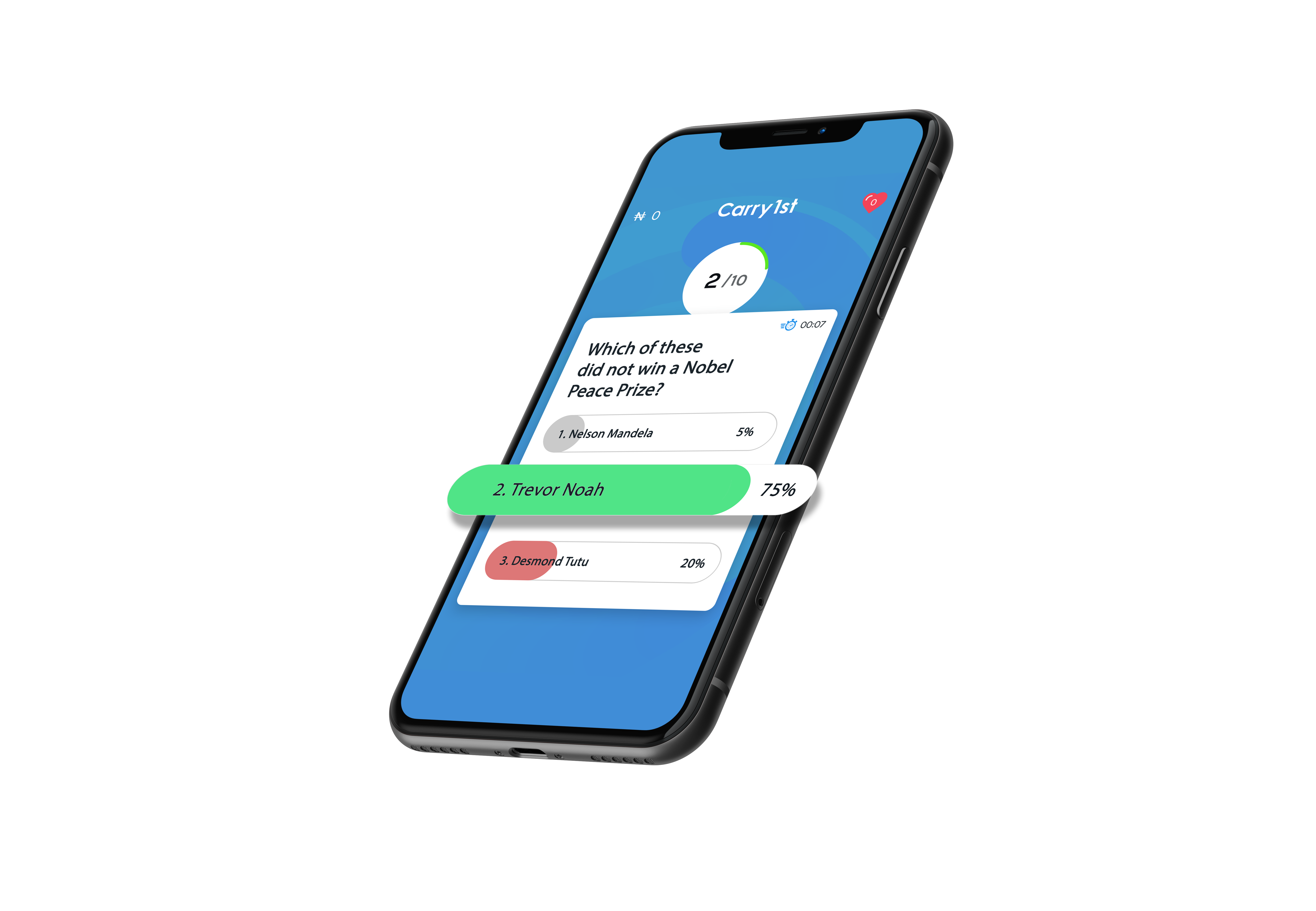
Carry1st has already launched two games as direct downloads from its site, Carry1st Trivia and Hyper!.

“In April, [Carry1st Trivia] did pretty well. It was the number one game in Nigeria, and Kenya for most of the year and did about one and a half million downloads.” Robbin-Coker said.
Carry1st Africa

Image Credit: Carry1st

The startup will use a portion of its latest round and overall capital to bring more unique content onto its platform. “In order to do that, you need cash…to help a developer finish a game or entice a strong game to work with you,” said Robbin-Coker.

The company will also expand its distribution channels, such as partnerships with mobile operators and the Carry1st Brand Ambassador program — a network of sales agents who promote and sell games across the continent.

The company will also invest in the gaming market and itself.

“We want to dedicate at least a million dollars to actually going out and acquiring users and scaling our user base. And then, the final piece is really around the the tech platform that we’re looking to build,” said Robbin-Coker.

That entails creating multiple channels and revenue points to develop, distribute, and invest in games on the continent, he explained.

Image Credits: Carry1st

Robbin-Coker compared the Carry1st’s strategy in Africa as something similar to Sea: an Asia regional mobile entertainment distribution platform — publicly traded and partially owned by Tencent — that incubated the popular Fornite game.

“We’re looking to be the number one regional publisher of [gaming] content in the region…the publisher of record and the app store,” said Robbin-Coker.

That entails developing and distributing not only games originating from the continent, but also serving as channel for gaming content from other continents coming into Africa.

That generates a consistent revenue stream for the startup, Robbin-Coker explained, but also creates opportunities for big creative wins.

“It’s a hits driven business. A single studio will work and toil in obscurity for a decade and then they’ll make Candy Crush. And then that would be worth $6 billion, very quickly,” Carry1st’s CEO said.

He and his team will use a portion of their $4 million in VC to invest in that potential gaming success story in Africa.

The company’s co-founder Lucy Parry directs aspirants to the company’s homepage. “There’s a big blue button that says ‘Pitch Your Game’ at the bottom of our website.”

Comments

Popular posts from this blog

Uber co-founder Garrett Camp steps back from board director role

Uber co-founder Garrett Camp is relinquishing his role as a board director and switching to board observer — where he says he’ll focus on product strategy for the ride hailing giant. Camp made the announcement in a short Medium post in which he writes of his decade at Uber: “I’ve learned a lot, and realized that I’m most helpful when focused on product strategy & design, and this is where I’d like to focus going forward.” “I will continue to work with Dara [Khosrowshahi, Uber CEO] and the product and technology leadership teams to brainstorm new ideas, iterate on plans and designs, and continue to innovate at scale,” he adds. “We have a strong and diverse team in place, and I’m confident everyone will navigate well during these turbulent times.” The Canadian billionaire entrepreneur signs off by saying he’s looking forward to helping Uber “brainstorm the next big idea”. Camp hasn’t been short of ideas over his career in tech. He’s the co-founder of the web 2.0 recommendatio...

Leading VCs discuss how COVID-19 has impacted the world of digital health

In December 2019, Extra Crunch spoke to a group of investors leading the charge in health tech to discuss where they saw the most opportunity in the space leading into 2020 . At the time, respondents highlighted startups in digital therapeutics, telehealth and mental health that were improving medical practitioner efficiency or streamlining the distribution of care, amongst a variety of other digital health markets that were garnering the most attention. Where top VCs are investing in digital health In the months since, the COVID-19 crisis has debilitated national healthcare systems and the global economy. Weaknesses in healthcare systems have become clearer than ever, while startups and capital providers have struggled to operate while wide swaths of the market effectively shut down. Given significant volatility and the rapid changes seen in the worlds of healthcare, venture and startups broadly, we wanted to understand which inefficiencies might have been brought to light, w...

News-reading app Flipboard expands local coverage, including coronavirus updates, to 12 more U.S. metros

Earlier this year, personalized news aggregation app Flipboard expanded into local news . The feature brought local news, sports, real estate, weather, transportation news and more to 23 cities across the U.S. Today, Flipboard is bringing local news to 12 more U.S. metros and is adding critical coronavirus local coverage to all of the 35 supported locales. The 12 new metros include the following:  Baltimore, Charlotte, Cleveland, Detroit, Indianapolis, Nashville, Pittsburgh, Orlando, Raleigh, Salt Lake City, St. Louis, and Tampa Bay. They join the 23 cities that were already supported:  Atlanta, Austin, Boston, Chicago, Dallas, Denver, Houston, Las Vegas, Los Angeles, Miami, Minneapolis-St. Paul, New Orleans, New York City, Philadelphia, Phoenix, Portland, Sacramento, San Diego, San Francisco Bay Area, Seattle, Toronto, Vancouver and Washington, D.C. To offer local news in its app, Flipboard works with area partners, big and small, like The Plain Dealer’s Cleveland.com , ...