In a statement posted to Facebook late Friday afternoon, Mark Zuckerberg offered up an explanation of why his company did not contextualize or remove posts from the accounts associated with President Donald Trump that appeared to incite violence against American citizens.
“We looked very closely at the post that discussed the protests in Minnesota to evaluate whether it violated our policies,” Zuckerberg wrote. “Our policy around incitement of violence allows discussion around state use of force, although I think today’s situation raises important questions about what potential limits of that discussion should be.”
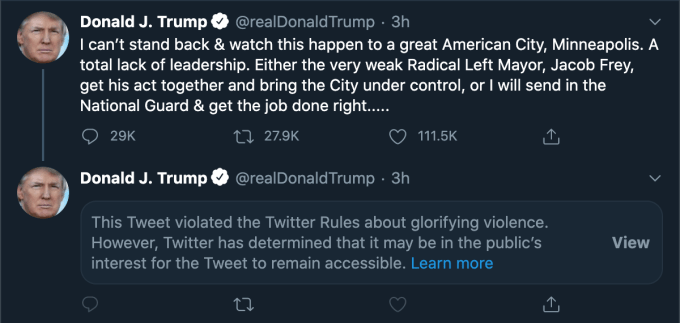
Facebook’s position stands in sharp contrast to recent decisions made by Twitter, with the approval of its chief executive, Jack Dorsey, to screen a tweet from the President on Thursday night using a “public interest notice” that indicated the tweet violated its rules glorifying violence. The public interest notice replaces the substance of what Trump wrote, meaning a user has to actively click through to view the offending tweet.
Critics excoriated Facebook and its CEO for its decision to take a hands off approach to the dissemination of misinformation and potential incitements to violence published by accounts associated with the President and the White House. Some of the criticism has even come from among the company’s employees.
“I have to say I am finding the contortions we have to go through incredibly hard to stomach,” one employee, quoted by The Verge, wrote in a comment on Facebook’s internal message board. “All this points to a very high risk of a violent escalation and civil unrest in November and if we fail the test case here, history will not judge us kindly.”
Zuckerberg defended Facebook’s position saying that it would not take any action on the posts from the President because “we think people need to know if the government is planning to deploy force.”
Facebook’s chief executive also drew a sharp contrast between Facebook’s response to the controversy and that of Twitter, which has provided a fact check for one of the President’s tweets and hidden Thursday’s tweet behind a warning label for violating its policies on violence.
“Unlike Twitter, we do not have a policy of putting a warning in front of posts that may incite violence because we believe that if a post incites violence, it should be removed regardless of whether it is newsworthy, even if it comes from a politician,” wrote Zuckerberg.
Twitter explained its decision in a statement. “This Tweet violates our policies regarding the glorification of violence based on the historical context of the last line, its connection to violence, and the risk it could inspire similar actions today,” the company said.
Twitter Comms
@TwitterComms
We have placed a public interest notice on this Tweet from @realdonaldtrump. https://twitter.com/realDonaldTrump/status/1266231100780744704 …
Donald J. Trump
Replying to @realDonaldTrump….These THUGS are dishonoring the memory of George Floyd, and I won’t let that happen. Just spoke to Governor Tim Walz and told him that the Military is with him all the way. Any difficulty and we will assume control but, when the looting starts, the shooting starts. Thank you!

“We’ve taken action in the interest of preventing others from being inspired to commit violent acts, but have kept the Tweet on Twitter because it is important that the public still be able to see the Tweet given its relevance to ongoing matters of public importance,” the Twitter statement continued.
Perhaps, as Zuckerberg suggests, Facebook will have an opportunity to provide some answers to the questions around what the limits should be around allowing the state discussion of incitements to violence. For now, the company’s response only begs more questions.
A link to the full post from Zuckerberg follows below:


Comments
Post a Comment