Javed, a middle-aged man, worked as a driver before losing that job earlier this year as coronavirus spread across India, prompting New Delhi to enforce a nationwide lockdown and temporarily curb several business activities.
There are millions of people like Javed in India today who have lost their livelihood in recent months. They are low-skilled workers and are currently struggling to secure another job.
An Apple alum thinks he can help. Through his app startup Apna, Nirmit Parikh is helping India’s workers learn new skills, connect with one another, and find jobs.
Parikh’s app is already changing lives. Javed, who could barely speak a few words in English before, recently posted a video on Apna app where he talked about his new job — processing raisins — in English.
In less than one year of its existence, Apna app — available on Android — has amassed over 1.2 million users.
The startup announced on Tuesday it has raised $8 million in its Series A financing round led by Lightspeed India and Sequoia Capital India. Greenoaks Capital and Rocketship VC also participated in the round.
In an interview with TechCrunch last week, Parikh said that these workers lack an organized community. “They are daily-wage workers. They rely on their friends to find jobs. This makes the prospects of them finding a job very difficult,” he said.
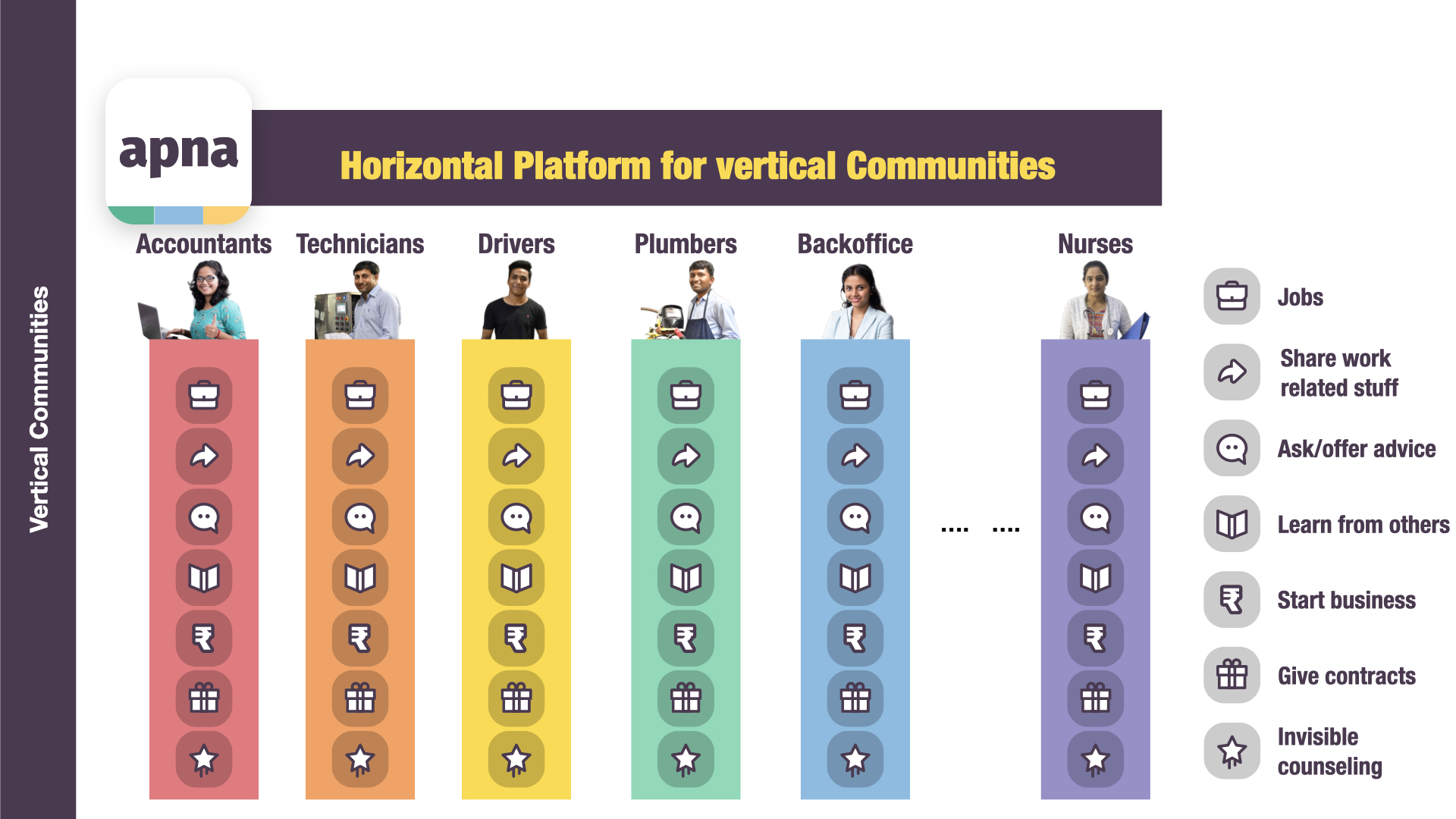
Apna app comprises of vertical communities for skilled professionals like carpenters, painters, field sales agents and many others.
“The most powerful thing for me about Apna is its communities — I’ve seen people help each other start a business, learn a new language or find a gig! Communities harbinger trust and make the model infinitely scalable,” said Vaibhav Agrawal, a Partner at Lightspeed India, in a statement.
The other issue they struggle with is their skillset. “An electrician would end up working decades doing the same job. If only they had access to upskilling courses — and just knew how beneficial it could be to them — they would stand to broaden their scope of work and significantly increase their earnings,” said Parikh.
Apna is addressing this gap in multiple ways. In addition to establishing a community, and rolling out upskilling courses, the startup allows users — most of whom are first time internet users — easily generate a virtual business card. The startup then shares these profiles with prospective employers. (Some of the firms that have hired from Apna app in recent weeks include Amazon, Big Basket, and HDFC Bank.)
In the last one month, Parikh said Apna has facilitated more than 1 million job interviews — up more than 3X month-on-month. During the same period, more than 3 million professional conversations occurred on the platform.
Parikh said he plans to use the fresh capital to expand Apna’s offerings, and help users launch their own businesses. He also plans to expand Apna, currently available in five Indian cities, outside of India in the future.
There are over 250 million blue and grey collar workers in India and providing them meaningful employment opportunities is one of the biggest challenges in our country, said Harshjit Sethi, Principal at Sequoia Capital India, in a statement.
“With internet usage in this demographic growing rapidly, further catalysed by the Jio effect, apps such as Apna can play a meaningful role in democratizing access to employment and skilling. Apna has built a unique product where users quickly come together in professional communities, an unmet need so far,” he added.
A handful of other players are also looking for ways to help. Last month, Google rolled out a feature in its search engine in India that allows users to create their virtual business card. The Android-maker also launched its jobs app Kormo in the country.


Comments
Post a Comment