The coronavirus pandemic has had a significant impact on the music industry, as artists who relied on live performances and concerts suddenly had the rug pulled out beneath them, impacting their ability to generate income. An upcoming feature in development at Spotify could help turn things around, by again connecting artists with their fans through ticketed live music events. This time, however, instead of helping fans find live concerts, as in the pre-pandemic days, the new feature will alert fans to the artist’s upcoming “virtual events.”
The feature was first discovered by reverse engineer Jane Manchun Wong and isn’t yet available in the public-facing version of the Spotify app.
Wong’s photos of the feature show the Spotify profile page for the artist BTS, where a new “Upcoming Virtual Events” section now appears. After tapping on the event, fans are informed that BTS will appear at a virtual concert on September 19. The event here is the 2020 iHeartRadio Music Festival, where BTS is scheduled to perform. In the example photos, Songkick is listed as the ticketing partner for this event.
A shift to include virtual event listings instead of live concerts wouldn’t be difficult for Spotify to implement. The company already works with ticketing partners including Ticketmaster, Songkick, Resident Advisor, Eventbrite, AXS and eplus in Japan. These ticketing sites have embraced virtual events amid the pandemic as way to keep their businesses afloat while in-person events were delayed and shut down over health concerns — or even became illegal under government lockdowns.
Spotify has a long history in connecting fans with artists. The company first added a concert discovery feature back in 2015. Though Spotify still doesn’t sell event tickets directly, it’s able to leverage its listening data and knowledge of a user’s location to suggest concerts to fans who may be interested in attending. Now it could push out these recommendations more broadly, as virtual events allow fans anywhere to attend — not just those nearby.
To launch a virtual events feature, Spotify would only need to slightly tweak existing partner agreements to gain access to their virtual event listings. Given the pandemic, it’s hard to imagine a partner would decline such an offer. And doing so also serves Spotify’s larger goal of being the preferred platform for artists.
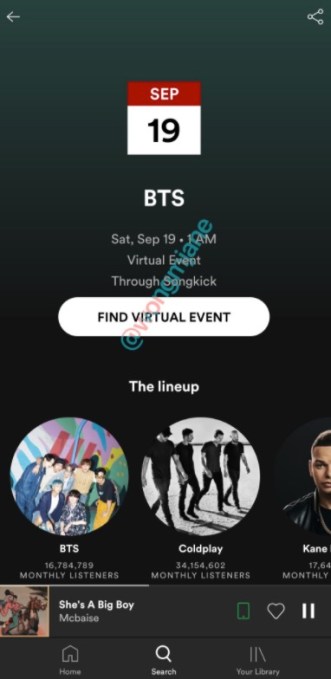
Image Credits: Jane Manchun Wong via Twitter
What’s less clear is whether Spotify considers the addition of virtual events a temporary measure to help artists manage their income before things return to normal, or if it believes there’s room to grow in the virtual events market in the long-term.
At present, virtual events have been helping musical artists weather the pandemic, but they’re not a replacement for live concerts for most. There are a few exceptions, of course. A group like BTS can pull in a record $20 million for one virtual show, but this is atypical. Elsewhere, the revenue loss from the pandemic can be extreme. This was apparent in Live Nation’s recently announced earnings, for example, where it said its revenue declined 98% due to pandemic shut downs.
Before the global health crisis, live performances had been a significant part of how musicians make money, with estimates putting earnings from live gigs at as much as 75% of top musicians’ earnings. While some artists have been trying to play around with newer formats like offering “tip jars” or broadcasting small performances over Facebook Live, this doesn’t necessary scale in the way that a larger performance or concert would have done. That’s opened the door for bigger event organizers, dedicated streaming companies, and larger music players to get involved.
Indeed, Spotify’s test and work on live events is coming at a time when we’re seeing a number of similar moves from streaming music companies. Just today, eMusic announced a partnership with 7Digital to launch eMusicLive (www.emusiclive.com), which it describes as a “virtual concert and monetisation platform.”
And yesterday, Rhapsody, which owns Napster, was acquired by an immersive music performance startup, MelodyVR, which has built a business around virtual concert performances. It has also been working on events with big organizers like Live Nation and others in the wake of COVID-19 rules preventing large in-person gatherings. MelodyVR has large ambitions to take its virtual concerts up a gear, now with the added benefit of providing a large streaming catalogue alongside those video experiences.
Others reportedly interested in building up virtual music performance services include Twitch, which is deepening its ties to the music industry. And don’t forget that Apple in 2018 quietly acquired Platoon, a group of A&R experts that could help the company be closer to sourcing and discovering talent and working with artists, perhaps also in the name of developing live performances.
Combined, these efforts could help push the livestream market forward, after steady increases on the monetization front over the years. Data from virtual concert platform StageIt, as reported by Billboard, noted fans were paying just $3.75, on average, for a 30-minute livestream in 2011. This has since grown to $16.50. Ahead of the pandemic, PricewaterhouseCoopers had projected live music events would generate $28.8 billion in revenue in 2020. But whether Spotify taps into the full potential of the market remains to be seen.
Spotify isn’t commenting on the feature.


Comments
Post a Comment