https://www.highperformancecpmgate.com/rgeesizw1?key=a9d7b2ab045c91688419e8e18a006621

Iron Man's Secret Armor Doubles as a Corporate Lawyer

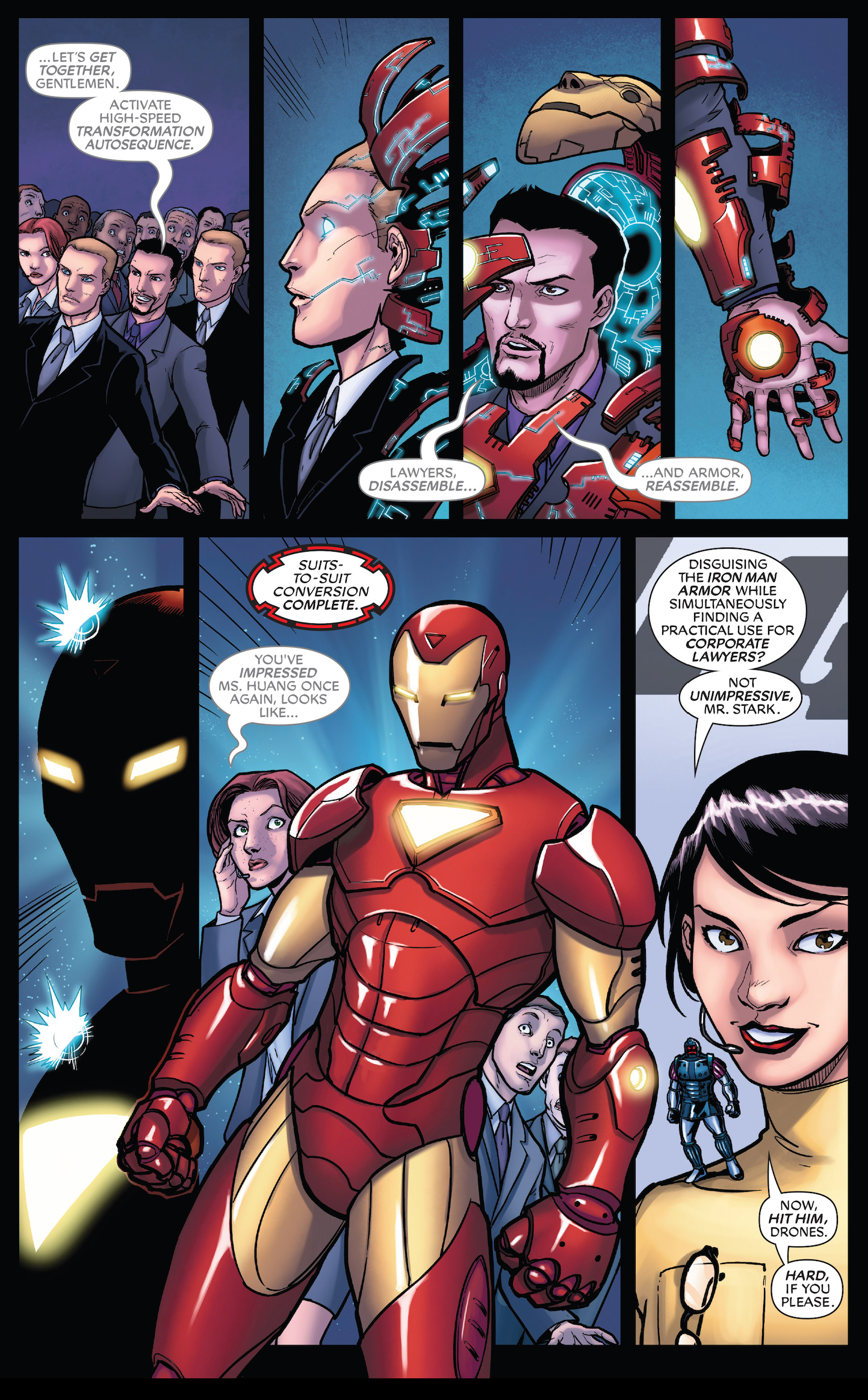
Marvel's Iron Man is one of the smartest characters in the Marvel Universe - and he's also one of the shrewdest businessmen on Earth, so it's no surprise that the genius, billionaire, playboy-philanthropist would quite literally invent a lawyer for himself. As the CEO of Stark Industries, Tony is often beset by legal troubles; lawyers accompanying him everywhere he goes would not be seen as out of the ordinary. In the short story collection Iron Man: Titanium, the tale Railguns, Power Ties and Titanium Men, written by Adam Warren with art by Salva Espin and colors by Rachelle Rosenberg, introduces readers to Tony Stark's very own "Lawyer Armor."

At the start of the story, Tony Stark accompanies Pepper Potts (along with bodyguards and lawyers) to a public meeting in a new skyscraper; the young Chief Technological Officer of the company Designed Intelligence, Huang Qiaolian appears ready to announce the company's IPO before dozens of potential investors. Instead, she kidnaps all the attendees and holds them hostage through the use of the Titanium Man: a robot that can also deploy smaller versions of itself. To add insult to injury, Huang Qiaolian isn't from Designed Intelligence at all, but Advanced Idea Mechanics, or A.I.M.


Huang Qiaolin's plan is revealed as she ushers the hostages toward high-speed electromagnetic elevators. They're not elevators; they're mass drivers, designed to launch the cabins into orbit where they'll reenter the atmosphere and land near an A.I.M. ship. But Tony Stark has a plan; he stands in the middle of his two lawyers and  initiates a high-speed transformation sequence. The two lawyers disassemble and form around Tony, creating a new armor. "Suits-to suit conversation complete," he says - while Huang stands amazed that Stark was able to find a practical use for corporate lawyers.
Tony Stark is no stranger to hiding his suits in plain sight. The most famous of Tony's concealed armors is the "suitcase armor" popularized in Iron Man 2, but was seen much earlier in the comics. Unlike the film, the suit wasn't disguised as the briefcase; it simply hid Tony's collapsible armor within. The Extremis armor was the logical next step; Tony stored the undersheath of the armor inside his bones, and moved it outside his skin with a mental command.

Thanks to the Lawyer Armor, Tony was able to rescue Pepper Potts and the passengers inside the elevators, destroy the Titanium Man and defeat Huang Qiaolin (who was later revealed to be a Life Model Decoy). Stark's legal troubles worked to his advantage in this instance. Iron Man's reputation for palling around with an entourage allowed one more suit of armor up his sleeve.

Comments

Popular posts from this blog

Uber co-founder Garrett Camp steps back from board director role

Uber co-founder Garrett Camp is relinquishing his role as a board director and switching to board observer — where he says he’ll focus on product strategy for the ride hailing giant. Camp made the announcement in a short Medium post in which he writes of his decade at Uber: “I’ve learned a lot, and realized that I’m most helpful when focused on product strategy & design, and this is where I’d like to focus going forward.” “I will continue to work with Dara [Khosrowshahi, Uber CEO] and the product and technology leadership teams to brainstorm new ideas, iterate on plans and designs, and continue to innovate at scale,” he adds. “We have a strong and diverse team in place, and I’m confident everyone will navigate well during these turbulent times.” The Canadian billionaire entrepreneur signs off by saying he’s looking forward to helping Uber “brainstorm the next big idea”. Camp hasn’t been short of ideas over his career in tech. He’s the co-founder of the web 2.0 recommendatio...

Leading VCs discuss how COVID-19 has impacted the world of digital health

In December 2019, Extra Crunch spoke to a group of investors leading the charge in health tech to discuss where they saw the most opportunity in the space leading into 2020 . At the time, respondents highlighted startups in digital therapeutics, telehealth and mental health that were improving medical practitioner efficiency or streamlining the distribution of care, amongst a variety of other digital health markets that were garnering the most attention. Where top VCs are investing in digital health In the months since, the COVID-19 crisis has debilitated national healthcare systems and the global economy. Weaknesses in healthcare systems have become clearer than ever, while startups and capital providers have struggled to operate while wide swaths of the market effectively shut down. Given significant volatility and the rapid changes seen in the worlds of healthcare, venture and startups broadly, we wanted to understand which inefficiencies might have been brought to light, w...

News-reading app Flipboard expands local coverage, including coronavirus updates, to 12 more U.S. metros

Earlier this year, personalized news aggregation app Flipboard expanded into local news . The feature brought local news, sports, real estate, weather, transportation news and more to 23 cities across the U.S. Today, Flipboard is bringing local news to 12 more U.S. metros and is adding critical coronavirus local coverage to all of the 35 supported locales. The 12 new metros include the following:  Baltimore, Charlotte, Cleveland, Detroit, Indianapolis, Nashville, Pittsburgh, Orlando, Raleigh, Salt Lake City, St. Louis, and Tampa Bay. They join the 23 cities that were already supported:  Atlanta, Austin, Boston, Chicago, Dallas, Denver, Houston, Las Vegas, Los Angeles, Miami, Minneapolis-St. Paul, New Orleans, New York City, Philadelphia, Phoenix, Portland, Sacramento, San Diego, San Francisco Bay Area, Seattle, Toronto, Vancouver and Washington, D.C. To offer local news in its app, Flipboard works with area partners, big and small, like The Plain Dealer’s Cleveland.com , ...