https://www.highperformancecpmgate.com/rgeesizw1?key=a9d7b2ab045c91688419e8e18a006621

Indian smartphone market grew by 4% in Q1, but projected to decline by 10% this year

India has emerged as one of the fastest growing smartphone markets in the last decade, reporting growth each quarter even as handset shipments slowed or declined elsewhere globally. But the world’s second largest smartphone is beginning to feel the coronavirus heat, too.

The Indian smartphone market grew by a modest 4% year-over-year in the quarter that ended on March 31, research firm Counterpoint said Friday evening. The shipment grew annually in January and February, when several firms launched their smartphones and unveiled aggressive promotional plans.

But in March, the shipment saw a 19% year-over-year dip, the firm said. Counterpoint estimated that the smartphone shipments in India will decline by 10% this year, compared to a 8.9% growth in 2019 and 10% growth in 2018.

The research firm also cautioned that India’s lockdown, ordered last month, has severely slowed down the local smartphone industry and it may take seven to eight months to get back on track. Currently, only select items such as grocery products are permitted to be sold in India.

Prachir Singh, Senior Research Analyst at Counterpoint Research, said the Covid-19 impact on India was relatively mild until mid-March. “However, economic activities declined as people save money in expectation of an extended period of uncertainty and an almost complete lockdown. Almost all smartphone manufacturing has been suspended. Further, with the social distancing norms, factories will be running at lower capacities even after the lockdown is lifted,” he said.

Overall, 31 million smartphone units shipped in India in Q1 2020. Chinese smartphone maker Xiaomi, which has held the tentpole position in what has become its biggest market globally for more than two years, widened its lead to command 30% of the market.
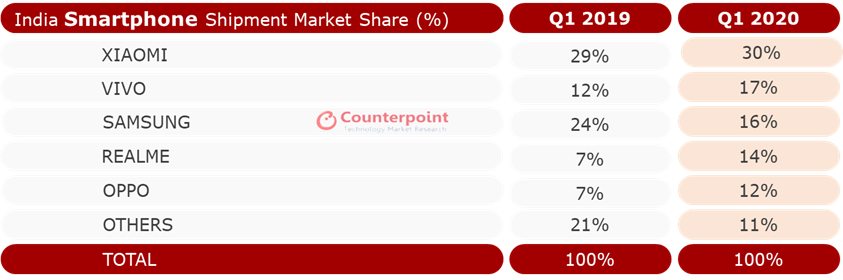
Vivo’s share grew to 17%, up from 12% during the same period last year. Samsung, which once led the Indian market, now sits at the third spot with 16% market share, down from 24% in Q1 2019. Apple maintained its recent momentum and grew by a strong 78% year-over-year in Q1 this year. It now commands 55% of the premium smartphone segment (handsets priced at $600 or above.).

More than 100 smartphone plants in India assemble or produce about 700,000 to 800,000 handsets a day, some of which are exported outside of the country. But the lockdown has halted the production and could cost the industry more than $3 billion to $4 billion in direct loss this year.

“We often draw parallels between India and China. But in China, their factories have adopted automation at various levels, something that is not the case in India,” said Tarun Pathak, a senior analyst at Counterpoint, earlier this week.

China, where smartphone sales declined by 38% annually in February this year, has already started to see recovery. Xiaomi said last month that its phone factories were already operating at more than 80% of their capacity. Globally, smartphone shipment declined by 14% in February, according to Counterpoint.

Comments

Popular posts from this blog

Uber co-founder Garrett Camp steps back from board director role

Uber co-founder Garrett Camp is relinquishing his role as a board director and switching to board observer — where he says he’ll focus on product strategy for the ride hailing giant. Camp made the announcement in a short Medium post in which he writes of his decade at Uber: “I’ve learned a lot, and realized that I’m most helpful when focused on product strategy & design, and this is where I’d like to focus going forward.” “I will continue to work with Dara [Khosrowshahi, Uber CEO] and the product and technology leadership teams to brainstorm new ideas, iterate on plans and designs, and continue to innovate at scale,” he adds. “We have a strong and diverse team in place, and I’m confident everyone will navigate well during these turbulent times.” The Canadian billionaire entrepreneur signs off by saying he’s looking forward to helping Uber “brainstorm the next big idea”. Camp hasn’t been short of ideas over his career in tech. He’s the co-founder of the web 2.0 recommendatio...

How the world’s largest cannabis dispensary avoids social media restrictions

Planet 13 is the world’s largest cannabis dispensary. Located in Las Vegas, blocks off the Strip, the facility is the size of a small Walmart. By design, it’s hard to miss. Planet 13 is upending the dispensary model. It’s big, loud and visitors are encouraged to photograph everything. As part of the cannabis industry, Planet 13 is heavily restricted on the type of content it can publish on Instagram, Facebook and other social media platforms. It’s not allowed to post pictures of buds or vapes on some sites. It can’t talk about pricing or product selection on others.   View this post on Instagram   A post shared by Morgan Celeste SF Blogger (@bayareabeautyblogger) on Jan 25, 2020 at 7:54pm PST Instead, Planet 13 encourages its thousands of visitors to take photos and videos. Starting with the entrance, the facility is full of surprises tailored for the ‘gram. As a business, Planet 13’s social media content is heavily restricted a...

Billionaire clothing dynasty heiress launches Everybody & Everyone to make fashion sustainable

Veronica Chou’s family has made its fortune at the forefront of the fast fashion business through investments in companies like Michael Kors and Tommy Hilfiger . But now, the heiress to an estimated $2.1 billion fortune is launching her own company, Everybody & Everyone , to prove that the fashion industry can be both environmentally sustainable and profitable. There’s no argument about the negative impacts of the fashion industry on the environment. The textiles industry primarily uses non-renewable resources — on the order of 98 million tons per year. That includes the oil to make synthetic fibers, fertilizers to grow cotton, and toxic chemicals to dye, treat, and produce the textiles used to make clothes. The greenhouse gas footprint from textiles production was roughly 1.2 billion tons of CO2 equivalent in 2015 — more than all international flights and maritime shipments combined (and a lot of those maritime shipments and international flights were hauling clothes). The lit...