Kara Carmichael has been an Instacart shopper for years in Orlando, Fla. It’s how she’s been able to support her family, she told TechCrunch. But she says she has noticed an increase in third-party bot activity that has made shopping “nearly impossible.”
Despite the high demand for Instacart amid the COVID-19 pandemic, shoppers like Carmichael are facing difficulties claiming orders within the shopper app. This is the result of what appears to be some sophisticated work by third-party apps like Ninja Hours, Sushopper and others.
“They grab the batches within a blink of an eye,” Carmichael said. “I can barely see the amounts offered. Sometimes I may even just receive a notification because the batch has been taken before it was even registered in my app.”
Ninja Hours appeared on the scene about a year ago in the Little Havana community in Miami, according to Logan B., an Instacart shopper with experience using Ninja Hours. Shoppers could pay Ninja Hours about $25 to $35 a week to get access to hours for the following week and in exchange, Ninja Hours would take over the shopper’s app to claim hours on their behalf. This was during a time when Instacart required shoppers to claim hours rather than on-demand orders.
Ninja Hours also provided account activations for immigrant workers without proper documentation. For $200, according to Logan, undocumented immigrants could pay Ninja Hours to create an account for them so they could shop.
Logan says Instacart eventually caught on to Ninja Hours, which forced the service to shut down. Ninja Hours then became Hours For You, which emerged in the fall, Logan says. Hours For You then folded into Sushopper earlier this year.
“The site would go offline for a week and then they would send you a text message,” he said. “It was always written in Spanish — really targeting the Latino community.”
Other shoppers didn’t seem to notice this was going on, Logan says, because Sushopper would claim the orders before they would even appear on the apps. But now that Sushopper has shut down, there’s a new service — one that is not quite as fast.
“There is definitely still a service out here because I’m not getting anything at all,” Logan, who has since stopped paying for early access to orders, said. “There’s no way anyone would be able to grab it that fast.”
What’s happening is that shoppers can see the orders come in, but then they pretty much immediately disappear. Below, you can see a gif of how the moment batches become available, one order immediately disappears.
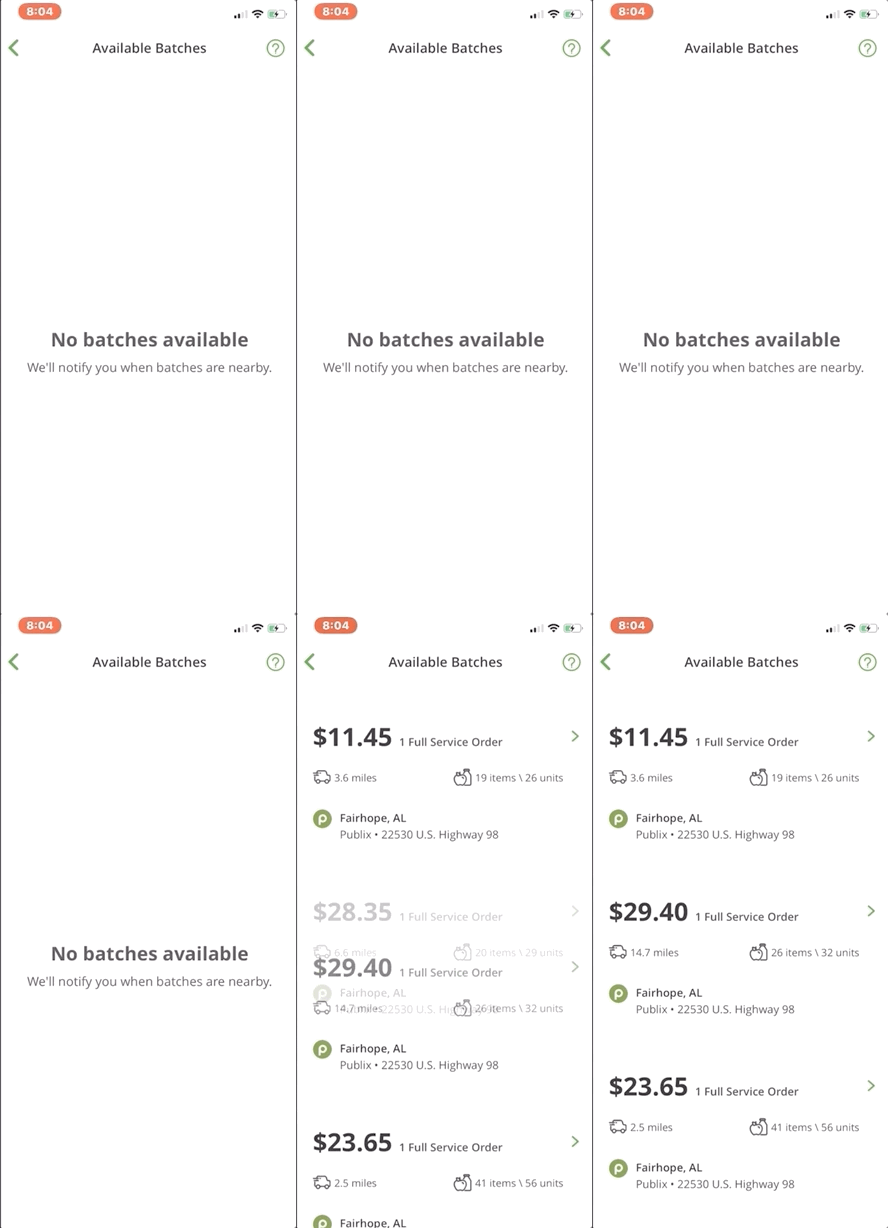
With this new service, which he doesn’t know the name of, the messages are coming in Portuguese. That leads him to believe it’s run by a different group of people.
“It’s so mainstream now and it seems just about everywhere is having a problem,” Logan said.
Instacart has acknowledged this is a practice that goes on but says that this is not a breach of its platform.
“The safety and security of the entire Instacart community is our top priority,” an Instacart spokesperson told TechCrunch. “We have several robust security measures in place to ensure the security of the Instacart platform. Selling or purchasing batches is not an authorized use of the Instacart platform and is a violation of our Terms of Service. Anyone found to be engaged in any type of inappropriate or fraudulent use of the Instacart platform, including selling or purchasing batches or utilizing any of these types of services, will have their accounts immediately deactivated. We advise shoppers not to engage with any individual or company that claims to provide priority access to batches on the platform, particularly those that request sensitive information such as Instacart usernames, passwords, and/or credit card information.”
Despite Instacart’s efforts, it’s gotten so bad that Carmichael ends up sitting in her car for hours waiting for a batch she can try to snag before the bots.
“My thumbs are sore and eyes are strained,” she said. “I’ve only managed to grab four orders. My livelihood is literally being snatched out from beneath me.”
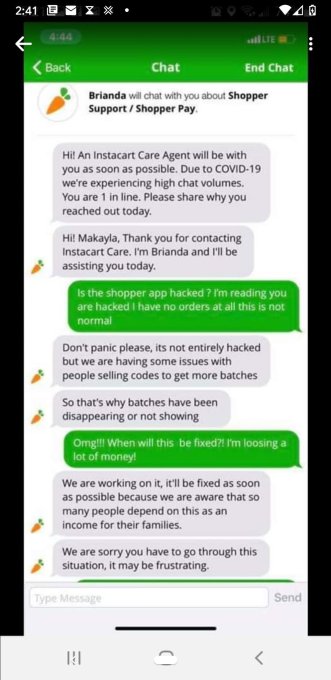
She and others have reached out to Instacart to report the issue, Carmichael said. But in her experience and the experience of those she knows, Instacart has not responded. Some shoppers, however, are able to get through to Instacart support about this issue. As you can see below, Instacart acknowledges an issue and told one shopper it will “be fixed as soon as possible.”
Before the bot activity ramped up in Orlando, Carmichael was receiving about 20 orders a week. During the week of March 16-22, for example, Carmichael completed 26 batches, according to documents reviewed by TechCrunch. Last week she was only able to claim 11. This week, she has only been able to get four batches.
This increase in bot activity comes at a time when Instacart is ramping up its hiring of full-service shoppers. Just yesterday, Instacart announced it’s adding 250,000 more shoppers to meet demand. That came after Instacart announced last month its plans to hire another 300,000 shoppers.
The increased number of full-service shoppers coupled with third-party bots quickly claiming orders, it’s no wonder why some shoppers are feeling frustrated. Behind the scenes, Instacart is working to ban unauthorized third parties from accepting batches. In the meantime, the company is recommending shoppers not engage with those services.


Comments
Post a Comment