https://www.highperformancecpmgate.com/rgeesizw1?key=a9d7b2ab045c91688419e8e18a006621

A new Android bug, Strandhogg 2.0, lets malware pose as real apps and steal user data

Security researchers have found a major vulnerability in almost every version of Android, which lets malware imitate legitimate apps to steal app passwords and other sensitive data.

The vulnerability, dubbed Strandhogg 2.0 (named after the Norse term for a hostile takeover) affects all devices running Android 9.0 and earlier. It’s the “evil twin” to an earlier bug of the same name, according to Norwegian security firm Promon, which discovered both vulnerabilities six months apart. Strandhogg 2.0 works by tricking a victim into thinking they’re entering their passwords on a legitimate app while instead interacting with a malicious overlay. Strandhogg 2.0 can also hijack other app permissions to siphon off sensitive user data, like contacts, photos, and track a victim’s real-time location.

The bug is said to be more dangerous than its predecessor because it’s “nearly undetectable,” Tom Lysemose Hansen, founder and chief technology officer at Promon, told TechCrunch.

The good news is that Promon said it has no evidence that hackers have used the bug in active hacking campaigns. The caveat is that there are “no good ways” to detect an attack. Fearing the bug could still be abused by hackers, Promon delayed releasing details of the bug until Google could fix the “critical”-rated vulnerability.

A spokesperson for Google told TechCrunch that the company also saw no evidence of active exploitation. “We appreciate the work of the researchers, and have released a fix for the issue they identified.” The spokesperson said Google Play Protect, an app screening service built-in to Android devices, blocks apps that exploit the Strandhogg 2.0 vulnerability.

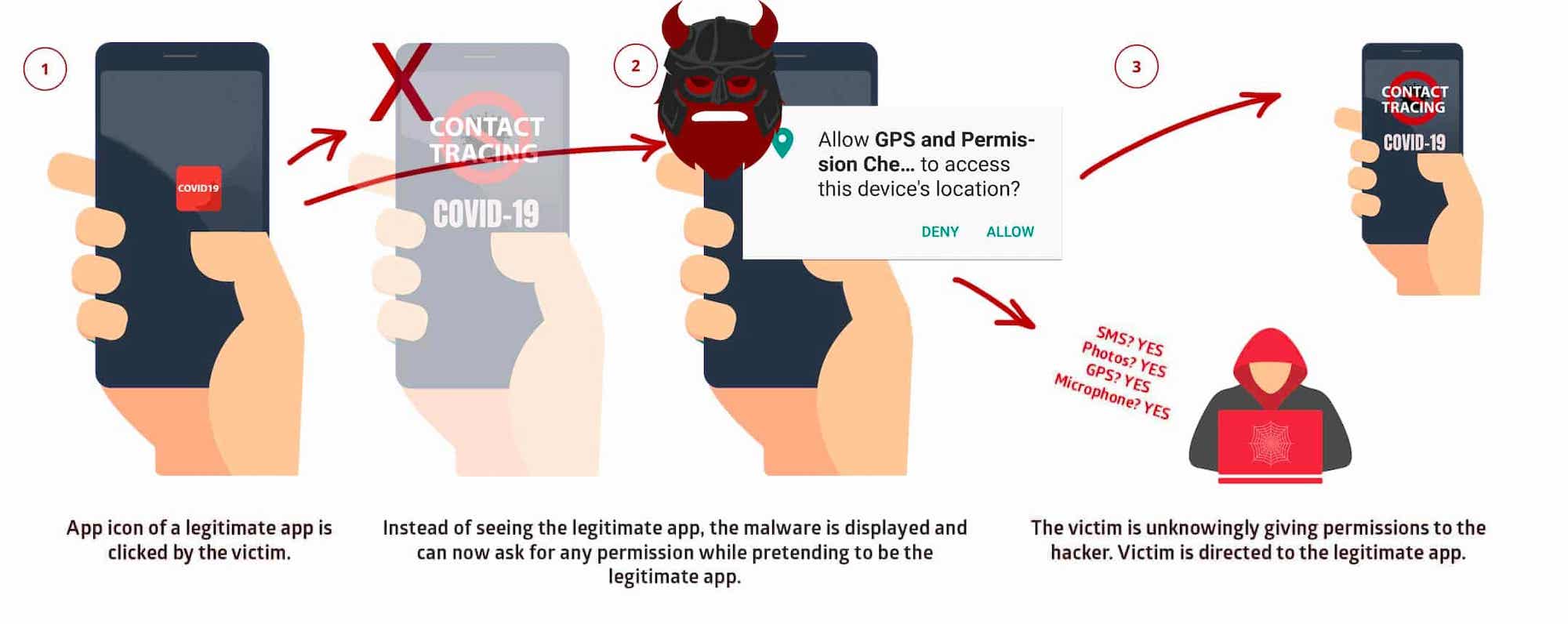
Standhogg 2.0 works by abusing Android’s multitasking system, which keeps tabs on every recently opened app so that the user can quickly switch back and forth. A victim would have to download a malicious app — disguised as a normal app — that can exploit the Strandhogg 2.0 vulnerability. Once installed and when a victim opens a legitimate app, the malicious app quickly hijacks the app and injects malicious content in its place, such as a fake login window.

When a victim enters their password on the fake overlay, their passwords are siphoned off to the hacker’s servers. The real app then appears as though the login was real.

Strandhogg 2.0 doesn’t need any Android permissions to run, but it can also hijack the permissions of other apps that have access to a victim’s contacts, photos, and messages by triggering a permissions request.

“If the permission is granted, then the malware now has this dangerous permission,” said Hansen.

Once that permission is granted, the malicious app can upload data from a user’s phone. The malware can upload entire text message conversations, said Hansen, allowing the hackers to defeat two-factor authentication protections.

The risk to users is likely low, but not zero. Promon said updating Android devices with the latest security updates — out now — will fix the vulnerability. Users are advised to update their Android devices as soon as possible.

Comments

Popular posts from this blog

Uber co-founder Garrett Camp steps back from board director role

Uber co-founder Garrett Camp is relinquishing his role as a board director and switching to board observer — where he says he’ll focus on product strategy for the ride hailing giant. Camp made the announcement in a short Medium post in which he writes of his decade at Uber: “I’ve learned a lot, and realized that I’m most helpful when focused on product strategy & design, and this is where I’d like to focus going forward.” “I will continue to work with Dara [Khosrowshahi, Uber CEO] and the product and technology leadership teams to brainstorm new ideas, iterate on plans and designs, and continue to innovate at scale,” he adds. “We have a strong and diverse team in place, and I’m confident everyone will navigate well during these turbulent times.” The Canadian billionaire entrepreneur signs off by saying he’s looking forward to helping Uber “brainstorm the next big idea”. Camp hasn’t been short of ideas over his career in tech. He’s the co-founder of the web 2.0 recommendatio...

How the world’s largest cannabis dispensary avoids social media restrictions

Planet 13 is the world’s largest cannabis dispensary. Located in Las Vegas, blocks off the Strip, the facility is the size of a small Walmart. By design, it’s hard to miss. Planet 13 is upending the dispensary model. It’s big, loud and visitors are encouraged to photograph everything. As part of the cannabis industry, Planet 13 is heavily restricted on the type of content it can publish on Instagram, Facebook and other social media platforms. It’s not allowed to post pictures of buds or vapes on some sites. It can’t talk about pricing or product selection on others.   View this post on Instagram   A post shared by Morgan Celeste SF Blogger (@bayareabeautyblogger) on Jan 25, 2020 at 7:54pm PST Instead, Planet 13 encourages its thousands of visitors to take photos and videos. Starting with the entrance, the facility is full of surprises tailored for the ‘gram. As a business, Planet 13’s social media content is heavily restricted a...

Billionaire clothing dynasty heiress launches Everybody & Everyone to make fashion sustainable

Veronica Chou’s family has made its fortune at the forefront of the fast fashion business through investments in companies like Michael Kors and Tommy Hilfiger . But now, the heiress to an estimated $2.1 billion fortune is launching her own company, Everybody & Everyone , to prove that the fashion industry can be both environmentally sustainable and profitable. There’s no argument about the negative impacts of the fashion industry on the environment. The textiles industry primarily uses non-renewable resources — on the order of 98 million tons per year. That includes the oil to make synthetic fibers, fertilizers to grow cotton, and toxic chemicals to dye, treat, and produce the textiles used to make clothes. The greenhouse gas footprint from textiles production was roughly 1.2 billion tons of CO2 equivalent in 2015 — more than all international flights and maritime shipments combined (and a lot of those maritime shipments and international flights were hauling clothes). The lit...