https://www.highperformancecpmgate.com/rgeesizw1?key=a9d7b2ab045c91688419e8e18a006621

Adobe’s ‘Liquid Mode’ uses AI to automatically redesign PDFs for mobile devices

We’ve probably all been there: you’ve been poking around your phone for an hour, deep in some sort of Google research rabbit hole. You finally find a link that almost certainly has the info you’ve been looking for. You tap it.. aaaand it’s a fifty page PDF. Now you get to pinch and zoom your way through a document that’s clearly not meant for a screen that fits in your hand.

Given that the file format is approaching its 30th birthday, it makes sense that PDFs aren’t exactly built for modern mobile devices. But neither PDFs or smartphones are going away anytime soon, so Adobe has been working on a way to make them play nicely together.

This morning Adobe is launching a feature it calls “Liquid Mode.” Liquid Mode taps Adobe’s AI engine, Sensei, to analyze a PDF and automatically rebuild it for mobile devices. It uses machine learning to chew through the PDF and try to work out what’s what — like the font changes that indicate a new section is starting, or how data is being displayed in a table — and reflow it all for smaller screens.

After a few months of quiet testing, Liquid Mode is being publicly rolled out in Adobe’s Acrobat Reader app for iOS and Android today with plans to bring it to desktops later. Adobe CTO Abhay Parasnis also tells me they’ve been working on an API that’ll allow similar functionality to be rolled into non-Adobe apps down the road.

When you open a PDF in Acrobat Reader, the app will try to determine if it’ll work with Liquid Mode; if so, the Liquid Mode button lights up. Tap the button and the file is sent to Adobe’s Document Cloud for processing. Once complete, users can tweak things like the font size and line spacing to their liking. Liquid Mode will use the headers/structure it detects to build a tappable table of contents where none existed before, allowing you to quickly hop from section to section. The whole thing is non-destructive, so nothing actually changes about the original PDF. Step back out of liquid mode, and you’re back at the original, unmodified PDF. 
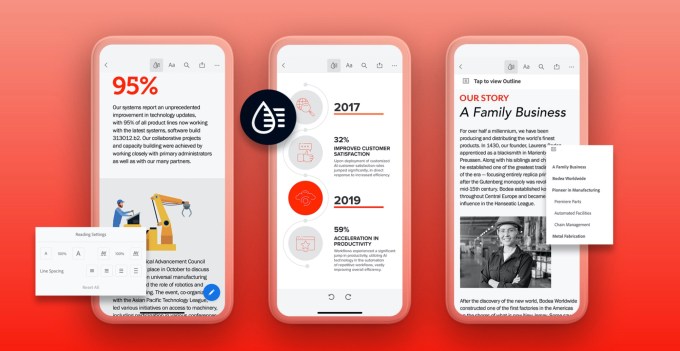
Image Credits: Adobe

We first heard about Adobe’s efforts here earlier this year; in an ExtraCrunch interview back in January, Parasnis outlined Adobe’s plans to bring AI and machine learning into just about everything the company does. Parasnis tells me that Liquid Mode is just the first step in giving Sensei an understanding of documents. Later, he notes, they want users to be able to hand Sensei a thirty page PDF and have it return a summary just a few pages long.

Comments

Popular posts from this blog

Uber co-founder Garrett Camp steps back from board director role

Uber co-founder Garrett Camp is relinquishing his role as a board director and switching to board observer — where he says he’ll focus on product strategy for the ride hailing giant. Camp made the announcement in a short Medium post in which he writes of his decade at Uber: “I’ve learned a lot, and realized that I’m most helpful when focused on product strategy & design, and this is where I’d like to focus going forward.” “I will continue to work with Dara [Khosrowshahi, Uber CEO] and the product and technology leadership teams to brainstorm new ideas, iterate on plans and designs, and continue to innovate at scale,” he adds. “We have a strong and diverse team in place, and I’m confident everyone will navigate well during these turbulent times.” The Canadian billionaire entrepreneur signs off by saying he’s looking forward to helping Uber “brainstorm the next big idea”. Camp hasn’t been short of ideas over his career in tech. He’s the co-founder of the web 2.0 recommendatio...

How the world’s largest cannabis dispensary avoids social media restrictions

Planet 13 is the world’s largest cannabis dispensary. Located in Las Vegas, blocks off the Strip, the facility is the size of a small Walmart. By design, it’s hard to miss. Planet 13 is upending the dispensary model. It’s big, loud and visitors are encouraged to photograph everything. As part of the cannabis industry, Planet 13 is heavily restricted on the type of content it can publish on Instagram, Facebook and other social media platforms. It’s not allowed to post pictures of buds or vapes on some sites. It can’t talk about pricing or product selection on others.   View this post on Instagram   A post shared by Morgan Celeste SF Blogger (@bayareabeautyblogger) on Jan 25, 2020 at 7:54pm PST Instead, Planet 13 encourages its thousands of visitors to take photos and videos. Starting with the entrance, the facility is full of surprises tailored for the ‘gram. As a business, Planet 13’s social media content is heavily restricted a...

Billionaire clothing dynasty heiress launches Everybody & Everyone to make fashion sustainable

Veronica Chou’s family has made its fortune at the forefront of the fast fashion business through investments in companies like Michael Kors and Tommy Hilfiger . But now, the heiress to an estimated $2.1 billion fortune is launching her own company, Everybody & Everyone , to prove that the fashion industry can be both environmentally sustainable and profitable. There’s no argument about the negative impacts of the fashion industry on the environment. The textiles industry primarily uses non-renewable resources — on the order of 98 million tons per year. That includes the oil to make synthetic fibers, fertilizers to grow cotton, and toxic chemicals to dye, treat, and produce the textiles used to make clothes. The greenhouse gas footprint from textiles production was roughly 1.2 billion tons of CO2 equivalent in 2015 — more than all international flights and maritime shipments combined (and a lot of those maritime shipments and international flights were hauling clothes). The lit...