https://www.highperformancecpmgate.com/rgeesizw1?key=a9d7b2ab045c91688419e8e18a006621

Google brings in BERT to improve its search results

Google today announced one of the biggest updates to its search algorithm in recent years. By using new neural networking techniques to better understand the intentions behind queries, Google says it can now offer more relevant results for about one in 10 searches in the U.S. in English (with support for other languages and locales coming later). For featured snippets, the update is already live globally.

In the world of search updates, where algorithm changes are often far more subtle, an update that affects 10% of searches is a pretty big deal (and will surely keep the world’s SEO experts up at night).

Google notes that this update will work best for longer, more conversational queries — and in many ways, that’s how Google would really like you to search these days, because it’s easier to interpret a full sentence than a sequence of keywords.
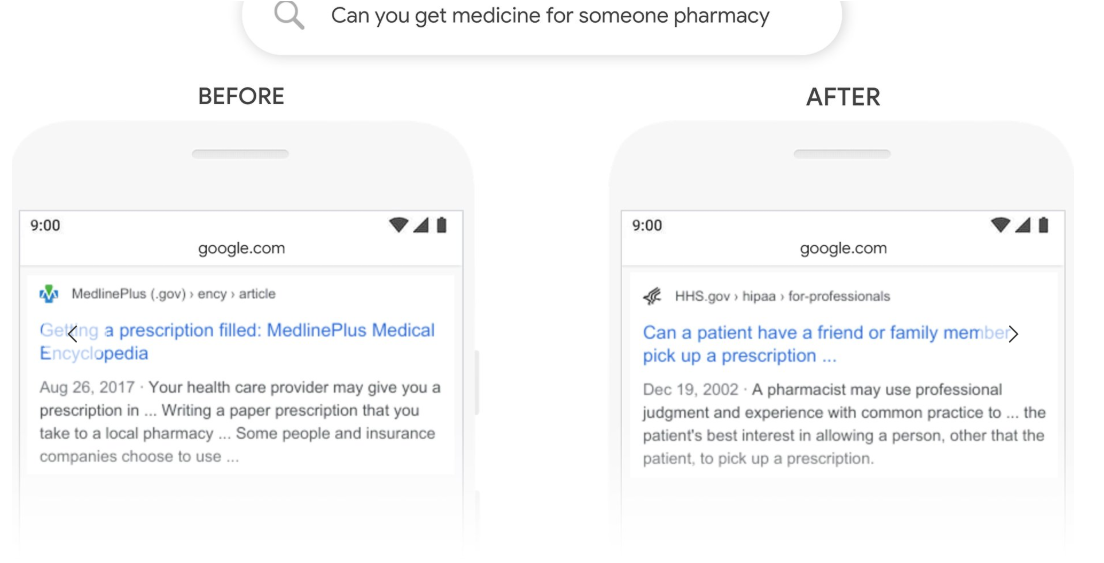
2019 10 25 0945 1The technology behind this new neural network is called “Bidirectional Encoder Representations from Transformers,” or BERT. Google first talked about BERT last year and open-sourced the code for its implementation and pre-trained models. Transformers are one of the more recent developments in machine learning. They work especially well for data where the sequence of elements is important, which obviously makes them a useful tool for working with natural language and, hence, search queries.

This BERT update also marks the first time Google is using its latest Tensor Processing Unit (TPU) chips to serve search results.

Ideally, this means that Google Search is now better able to understand exactly what you are looking for and provide more relevant search results and featured snippets. The update started rolling out this week, so chances are you are already seeing some of its effects in your search results.

Comments

Popular posts from this blog

Uber co-founder Garrett Camp steps back from board director role

Uber co-founder Garrett Camp is relinquishing his role as a board director and switching to board observer — where he says he’ll focus on product strategy for the ride hailing giant. Camp made the announcement in a short Medium post in which he writes of his decade at Uber: “I’ve learned a lot, and realized that I’m most helpful when focused on product strategy & design, and this is where I’d like to focus going forward.” “I will continue to work with Dara [Khosrowshahi, Uber CEO] and the product and technology leadership teams to brainstorm new ideas, iterate on plans and designs, and continue to innovate at scale,” he adds. “We have a strong and diverse team in place, and I’m confident everyone will navigate well during these turbulent times.” The Canadian billionaire entrepreneur signs off by saying he’s looking forward to helping Uber “brainstorm the next big idea”. Camp hasn’t been short of ideas over his career in tech. He’s the co-founder of the web 2.0 recommendatio...

How the world’s largest cannabis dispensary avoids social media restrictions

Planet 13 is the world’s largest cannabis dispensary. Located in Las Vegas, blocks off the Strip, the facility is the size of a small Walmart. By design, it’s hard to miss. Planet 13 is upending the dispensary model. It’s big, loud and visitors are encouraged to photograph everything. As part of the cannabis industry, Planet 13 is heavily restricted on the type of content it can publish on Instagram, Facebook and other social media platforms. It’s not allowed to post pictures of buds or vapes on some sites. It can’t talk about pricing or product selection on others.   View this post on Instagram   A post shared by Morgan Celeste SF Blogger (@bayareabeautyblogger) on Jan 25, 2020 at 7:54pm PST Instead, Planet 13 encourages its thousands of visitors to take photos and videos. Starting with the entrance, the facility is full of surprises tailored for the ‘gram. As a business, Planet 13’s social media content is heavily restricted a...

Leading VCs discuss how COVID-19 has impacted the world of digital health

In December 2019, Extra Crunch spoke to a group of investors leading the charge in health tech to discuss where they saw the most opportunity in the space leading into 2020 . At the time, respondents highlighted startups in digital therapeutics, telehealth and mental health that were improving medical practitioner efficiency or streamlining the distribution of care, amongst a variety of other digital health markets that were garnering the most attention. Where top VCs are investing in digital health In the months since, the COVID-19 crisis has debilitated national healthcare systems and the global economy. Weaknesses in healthcare systems have become clearer than ever, while startups and capital providers have struggled to operate while wide swaths of the market effectively shut down. Given significant volatility and the rapid changes seen in the worlds of healthcare, venture and startups broadly, we wanted to understand which inefficiencies might have been brought to light, w...