https://www.highperformancecpmgate.com/rgeesizw1?key=a9d7b2ab045c91688419e8e18a006621

SpaceX wants to land Starship on the Moon before 2022, then do cargo runs for 2024 human landing

Speaking at a quick series of interviews with commercial space company’s at this year’s annual International Astronautical Congress, SpaceX President and COO Gwynne Shotwell shed a little more light on her company’s current thinking with regards to the mission timelines for its forthcoming Starship spacefaring vehicle. Starship, currently in parallel development at SpaceX’s South Texas and Florida facilities, is intended to be an all-purpose successor to, and replacement for, both Falcon 9 and Falcon Heavy, with a higher payload capacity and the ability to reach the Moon and eventually Mars.

“Aspirationally, we want to get Starship to orbit within a year,” Shotwell said. “We definitely want to land it on the Moon before 2022. We want to […] stage cargo there to make sure that there are resources for the folks that ultimately land on the moon by 2024, if things go well, so that’s the aspirational timeframe.”

That’s an ambitious timeline, and as Shotwell herself repeatedly stated, these are “aspirational” timelines. In the space industry, as well as in tech, it’s not uncommon for leadership to set aggressive schedules in order to drive the teams working on projects to work at the limits of what’s actually possible. SpaceX CEO Elon Musk is also known for working to timelines that often don’t match up with reality, and Shotwell alluded to Musk’s ambitious goal setting as a virtue in another part of her on-stage interview at IAC.
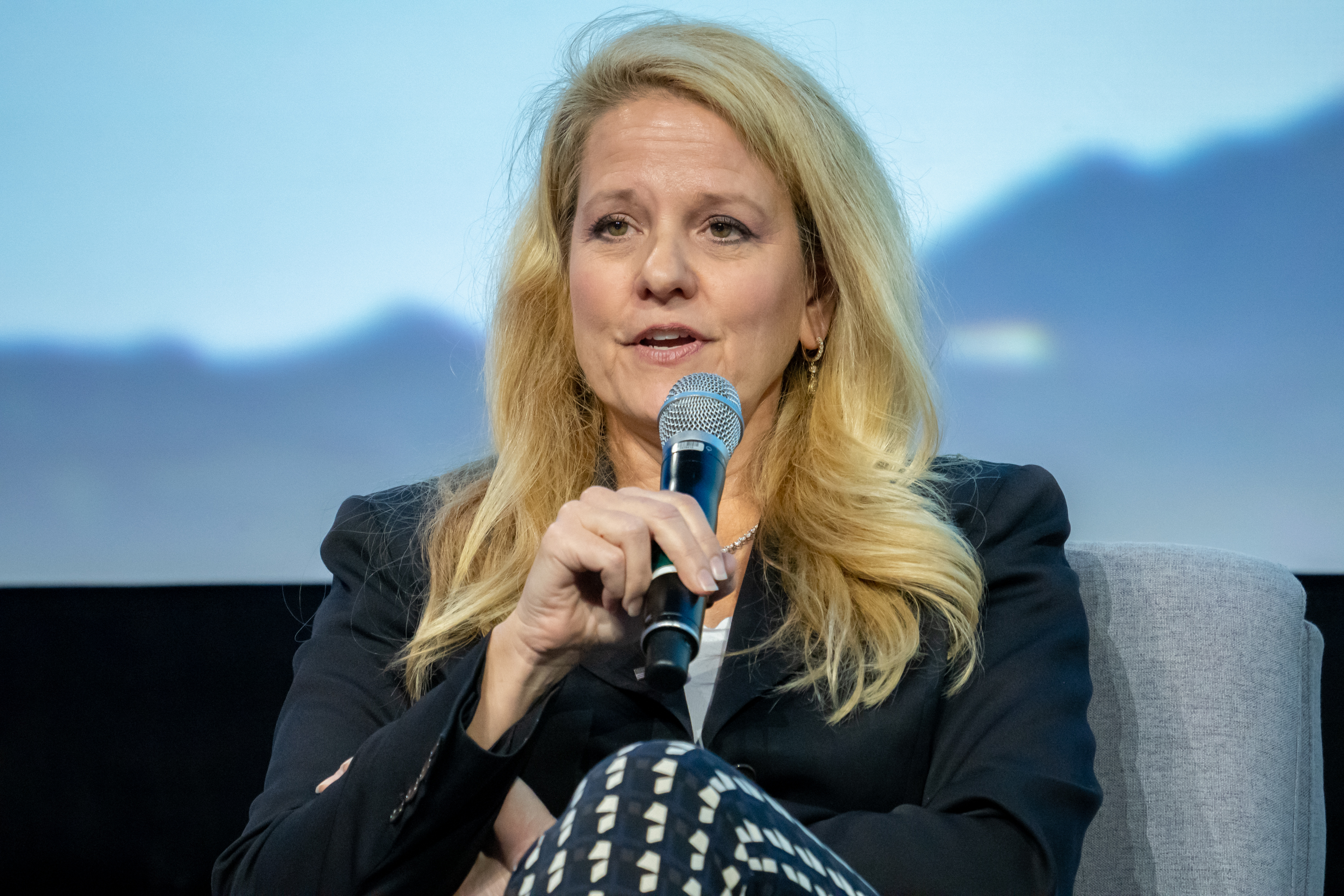
SpaceX President and COO Gwynne Shotwell at IAC 2019

SpaceX President and COO Gwynne Shotwell at IAC 2019 in Washington, D.C.

“Elon puts out these incredibly audacious goals and people say ‘You’re not going to do it, you’ll never get to orbit, you’ll never get a real rocket to orbit, […] you’ll never get Heavy to orbit, you’ll never get Dragon to the station, you’ll never get Dragon back, and you’ll never land a rocket,'” she said. “So, frankly, I love when people say we can’t do it, because it motivates my fantastic 6,500 employees to go do that thing.”

SpaceX has previously discussed its goal of starting its first orbital test flights of Starship within as little as a year. So far, the company has built and tested a so-called ‘Starhopper’ demonstration vehicle, which consisted of just the base of the vehicle and one of the Raptor engines it will use for its new Starship launch system and Super Heavy booster. After completing successful low-altitude flights with that vehicle, SpaceX moved on to assembling its Mk1 and Mk2 Starship test vehicles, which represent the full scale of the ultimate orbital spacecraft, and which are being built by teams in Boca Chica and Cape Canaveral, respectively. These will perform high-altitude testing, before SpaceX builds additional prototypes for orbital, and ultimately human test flights.

SpaceX already has already been contracted by Intuitive Machines and ispace, both companies working with NASA to delivery payloads to the Moon ahead of its 2024 Artemis program human Moon landing, but these payload missions all specify using Falcon 9 to deliver their payloads.

Comments

Popular posts from this blog

Uber co-founder Garrett Camp steps back from board director role

Uber co-founder Garrett Camp is relinquishing his role as a board director and switching to board observer — where he says he’ll focus on product strategy for the ride hailing giant. Camp made the announcement in a short Medium post in which he writes of his decade at Uber: “I’ve learned a lot, and realized that I’m most helpful when focused on product strategy & design, and this is where I’d like to focus going forward.” “I will continue to work with Dara [Khosrowshahi, Uber CEO] and the product and technology leadership teams to brainstorm new ideas, iterate on plans and designs, and continue to innovate at scale,” he adds. “We have a strong and diverse team in place, and I’m confident everyone will navigate well during these turbulent times.” The Canadian billionaire entrepreneur signs off by saying he’s looking forward to helping Uber “brainstorm the next big idea”. Camp hasn’t been short of ideas over his career in tech. He’s the co-founder of the web 2.0 recommendatio...

Leading VCs discuss how COVID-19 has impacted the world of digital health

In December 2019, Extra Crunch spoke to a group of investors leading the charge in health tech to discuss where they saw the most opportunity in the space leading into 2020 . At the time, respondents highlighted startups in digital therapeutics, telehealth and mental health that were improving medical practitioner efficiency or streamlining the distribution of care, amongst a variety of other digital health markets that were garnering the most attention. Where top VCs are investing in digital health In the months since, the COVID-19 crisis has debilitated national healthcare systems and the global economy. Weaknesses in healthcare systems have become clearer than ever, while startups and capital providers have struggled to operate while wide swaths of the market effectively shut down. Given significant volatility and the rapid changes seen in the worlds of healthcare, venture and startups broadly, we wanted to understand which inefficiencies might have been brought to light, w...

News-reading app Flipboard expands local coverage, including coronavirus updates, to 12 more U.S. metros

Earlier this year, personalized news aggregation app Flipboard expanded into local news . The feature brought local news, sports, real estate, weather, transportation news and more to 23 cities across the U.S. Today, Flipboard is bringing local news to 12 more U.S. metros and is adding critical coronavirus local coverage to all of the 35 supported locales. The 12 new metros include the following:  Baltimore, Charlotte, Cleveland, Detroit, Indianapolis, Nashville, Pittsburgh, Orlando, Raleigh, Salt Lake City, St. Louis, and Tampa Bay. They join the 23 cities that were already supported:  Atlanta, Austin, Boston, Chicago, Dallas, Denver, Houston, Las Vegas, Los Angeles, Miami, Minneapolis-St. Paul, New Orleans, New York City, Philadelphia, Phoenix, Portland, Sacramento, San Diego, San Francisco Bay Area, Seattle, Toronto, Vancouver and Washington, D.C. To offer local news in its app, Flipboard works with area partners, big and small, like The Plain Dealer’s Cleveland.com , ...