https://www.highperformancecpmgate.com/rgeesizw1?key=a9d7b2ab045c91688419e8e18a006621

Hyundai is launching Botride, a robotaxi service in California with Pony.ai and Via

A fleet of electric, autonomous Hyundai Kona crossovers — equipped with a self-driving system from Chinese autonomous startup Pony.ai and Via’s ride-hailing platform, will start shuttling customers on public roads next week.

The robotaxi service called BotRide will operate on public roads in Irvine, California, beginning November 4. This isn’t a driverless service; there will be a human safety driver behind the wheel at all times. But it is one of the few ride-hailing pilots on California roads. Only four companies, AutoX, Pony.ai, Waymo and Zoox have permission to operate a ride-hailing service using autonomous vehicles in the state of the California.

Customers will be able to order rides through a smartphone app, which will direct passengers to nearby stops for pick up and drop off. Via’s expertise is on shared rides, and this platform aims for the same multiple rider goal. Via’s platform handles the on-demand ride-hailing features such as booking, passenger and vehicle assignment and vehicle identification (QR code). Via has two sides to its business. The company operates consumer-facing shuttles in Chicago, Washington, D.C. and New York. It also partners with cities and transportation authorities — and now automakers launching robotaxi services — giving clients access to their platform to deploy their own shuttles.

Hyundai said BotRide is “validating its user experience in preparation for a fully driverless future.” Hyundai didn’t explain when this driverless future might arrive. Whatever this driverless future ends up looking like, Hyundai sees this pilot as a critical marker along the way.
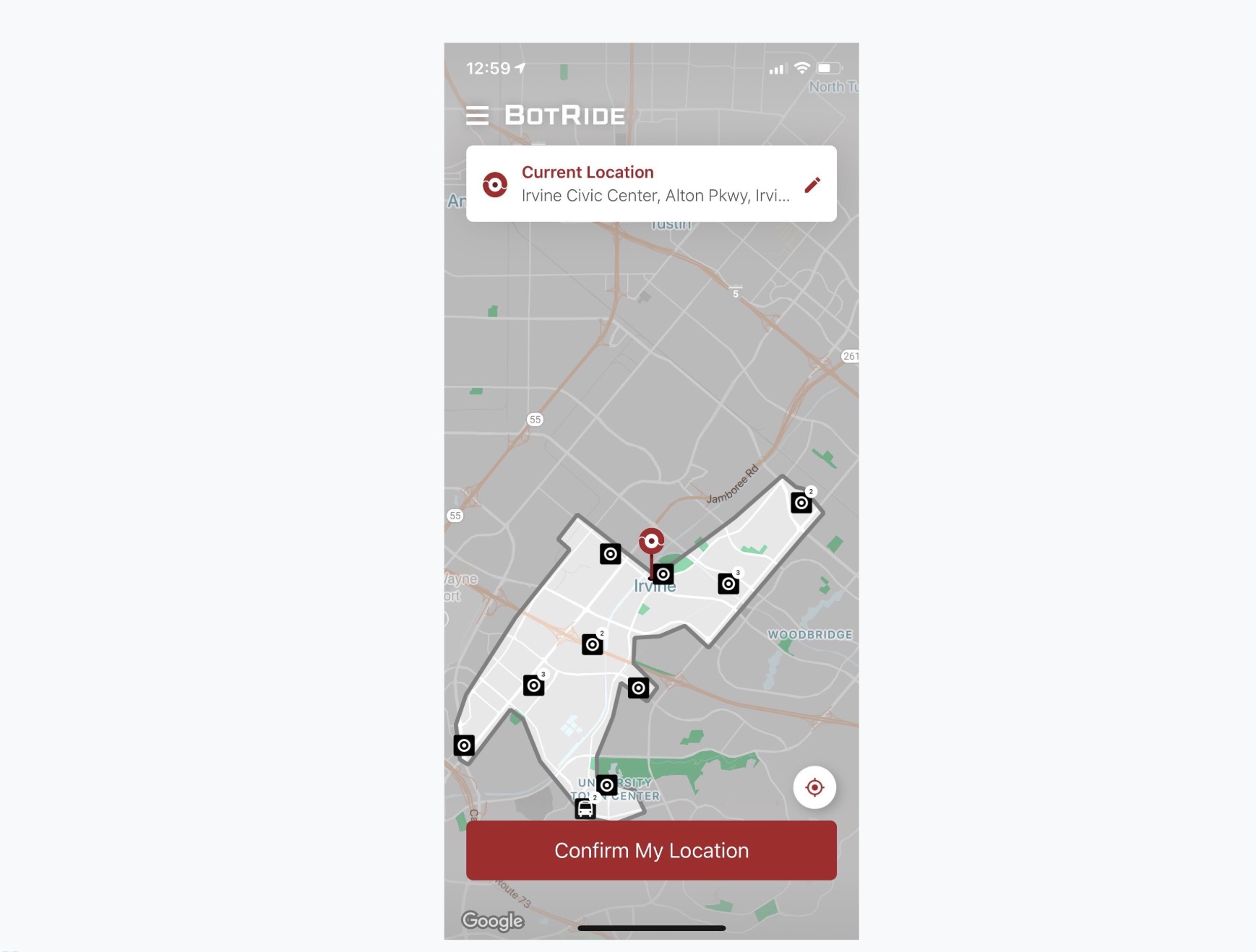
Coverage area of Hyundai robotaxi pilot

Hyundai said it is using BotRide to study consumer behavior in an autonomous ride-sharing environment, according to Christopher Chang, head of business development, strategy and technology division, Hyundai Motor Company.

“The BotRide pilot represents an important step in the deployment and eventual commercialization of a growing new mobility business,” said Daniel Han, manager, Advanced Product Strategy, Hyundai Motor America.

Hyundai might be the household name behind BotRide, but Pony.ai and Via are doing much of the heavy lifting. Pony.ai is a relative newcomer to the AV world, but it has already raised $300 million on a $1.7 billion valuation and locked in partnerships with Toyota and Hyundai.

The company, which has operations in China and California and about 500 employees globally, was founded in late 2016 with backing from Sequoia Capital China, IDG Capital and Legend Capital.

It’s also one of the few autonomous vehicle companies to have both a permit with the California Department of Motor Vehicles to test AVs on public roads and permission from the California Public Utilities Commission to use these vehicles in a ride-hailing service. Under rules established by the CPUC, Pony.ai cannot charge for rides.

Comments

Popular posts from this blog

Uber co-founder Garrett Camp steps back from board director role

Uber co-founder Garrett Camp is relinquishing his role as a board director and switching to board observer — where he says he’ll focus on product strategy for the ride hailing giant. Camp made the announcement in a short Medium post in which he writes of his decade at Uber: “I’ve learned a lot, and realized that I’m most helpful when focused on product strategy & design, and this is where I’d like to focus going forward.” “I will continue to work with Dara [Khosrowshahi, Uber CEO] and the product and technology leadership teams to brainstorm new ideas, iterate on plans and designs, and continue to innovate at scale,” he adds. “We have a strong and diverse team in place, and I’m confident everyone will navigate well during these turbulent times.” The Canadian billionaire entrepreneur signs off by saying he’s looking forward to helping Uber “brainstorm the next big idea”. Camp hasn’t been short of ideas over his career in tech. He’s the co-founder of the web 2.0 recommendatio...

How the world’s largest cannabis dispensary avoids social media restrictions

Planet 13 is the world’s largest cannabis dispensary. Located in Las Vegas, blocks off the Strip, the facility is the size of a small Walmart. By design, it’s hard to miss. Planet 13 is upending the dispensary model. It’s big, loud and visitors are encouraged to photograph everything. As part of the cannabis industry, Planet 13 is heavily restricted on the type of content it can publish on Instagram, Facebook and other social media platforms. It’s not allowed to post pictures of buds or vapes on some sites. It can’t talk about pricing or product selection on others.   View this post on Instagram   A post shared by Morgan Celeste SF Blogger (@bayareabeautyblogger) on Jan 25, 2020 at 7:54pm PST Instead, Planet 13 encourages its thousands of visitors to take photos and videos. Starting with the entrance, the facility is full of surprises tailored for the ‘gram. As a business, Planet 13’s social media content is heavily restricted a...

Leading VCs discuss how COVID-19 has impacted the world of digital health

In December 2019, Extra Crunch spoke to a group of investors leading the charge in health tech to discuss where they saw the most opportunity in the space leading into 2020 . At the time, respondents highlighted startups in digital therapeutics, telehealth and mental health that were improving medical practitioner efficiency or streamlining the distribution of care, amongst a variety of other digital health markets that were garnering the most attention. Where top VCs are investing in digital health In the months since, the COVID-19 crisis has debilitated national healthcare systems and the global economy. Weaknesses in healthcare systems have become clearer than ever, while startups and capital providers have struggled to operate while wide swaths of the market effectively shut down. Given significant volatility and the rapid changes seen in the worlds of healthcare, venture and startups broadly, we wanted to understand which inefficiencies might have been brought to light, w...