Cobee, a Spanish fintech startup that has developed an employee benefit management app and accompanying card, has closed €2.1 million in “pre-Series A” funding.
The round was co-led by Speedinvest, and Target Global. Other backers include Chris Bouwer (co-founder of Adyen) and existing investors Encomenda Smart Capital, BStartup (Banco Sabadell), Lanai Partners and Abac Nest.
Founded in 2018 by Borja Aranguren and Daniel Olea, Cobee aims to help employees “leverage better economic performance” from their salary via a range of employee benefits and discounts offered through the platform. These are managed within the Cobee app and redeemed through use of the Cobee payment card.
The draw for companies signing up is that Cobee already claims its platform has higher engagement than many existing employee benefit programmes. And by being a fully digital and automated solution, there is considerably less administration needed to manage the programme.
“We realized that there is an increasing number of solutions that are being sold as benefits or products to the end employees through their HR department (gyms, insurance products, perks, vouchers, salary sacrifice formulas, etc.),” Cobee co-founder and CEO Borja Aranguren tells TechCrunch. “This, on the one hand, means administrative hassle for the HR departments to manage all the different providers and processes and, most importantly, on the other hand, brings a totally fragmented and unclear value proposition for the employee”.
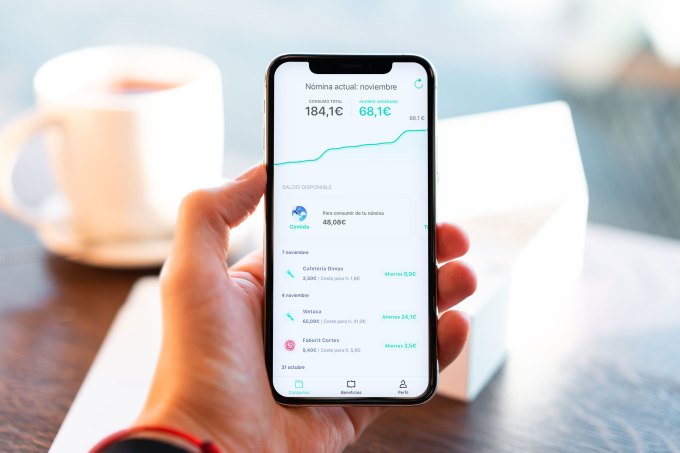
With this problem in mind, Aranguren and Olea set out to build Cobee, which the pair describe as a fintech HR solution that empowers employees to consume their compensation and benefits on-demand.
“All our efforts are focused on making employees feel happy about their benefits, trying to unify the value proposition in an understandable and easy to use formula,” Aranguren explains. “For the companies, we offer an easy-to-use SaaS platform to configure their benefit offering and upload their employees. For the employees, it is an app and a payment card to consumer those benefits as they like, with funds coming from a company subsidy or from their own salary”.
The current Cobee offering includes benefits like meals, transportation, childcare, health insurance and training courses. Additional options, such as gym membership, are said to be coming in the next few months.
“Our product can cater for companies of all sizes, from SMEs or startups to large corporations of any sector,” adds Aranguren. “However, our main target segment are those companies ranging between 50 to 5,000 employees. We have customers and users like Petronas, Avis Budget Group, Auto1 Group, Opinno, Glovo, and Willis Towers Watson”.
Meanwhile, Cobee says it will use the new funding to “scale up its business model” in Spain and expand into international markets. To support its mission to become a European category leader, the company plans to strengthen its team and enhance its platform by integrating new products and benefits.
The business model is straightforward, too: Cobee charges companies a SaaS fee per active employee. “We follow a pure success-based approach and we only win if the employees win, which, after all, makes the companies win,” says the Cobee CEO. “Besides that, we leverage purchasing volumes to build a marketplace that we can monetize and that also allows us to create savings that can be transferred to our end customers/employees”.


Comments
Post a Comment