AngelList, a platform that helps startup founders discover and connect to angel investors and job seekers, on Wednesday branched out to a new category in India to further serve the ecosystem.
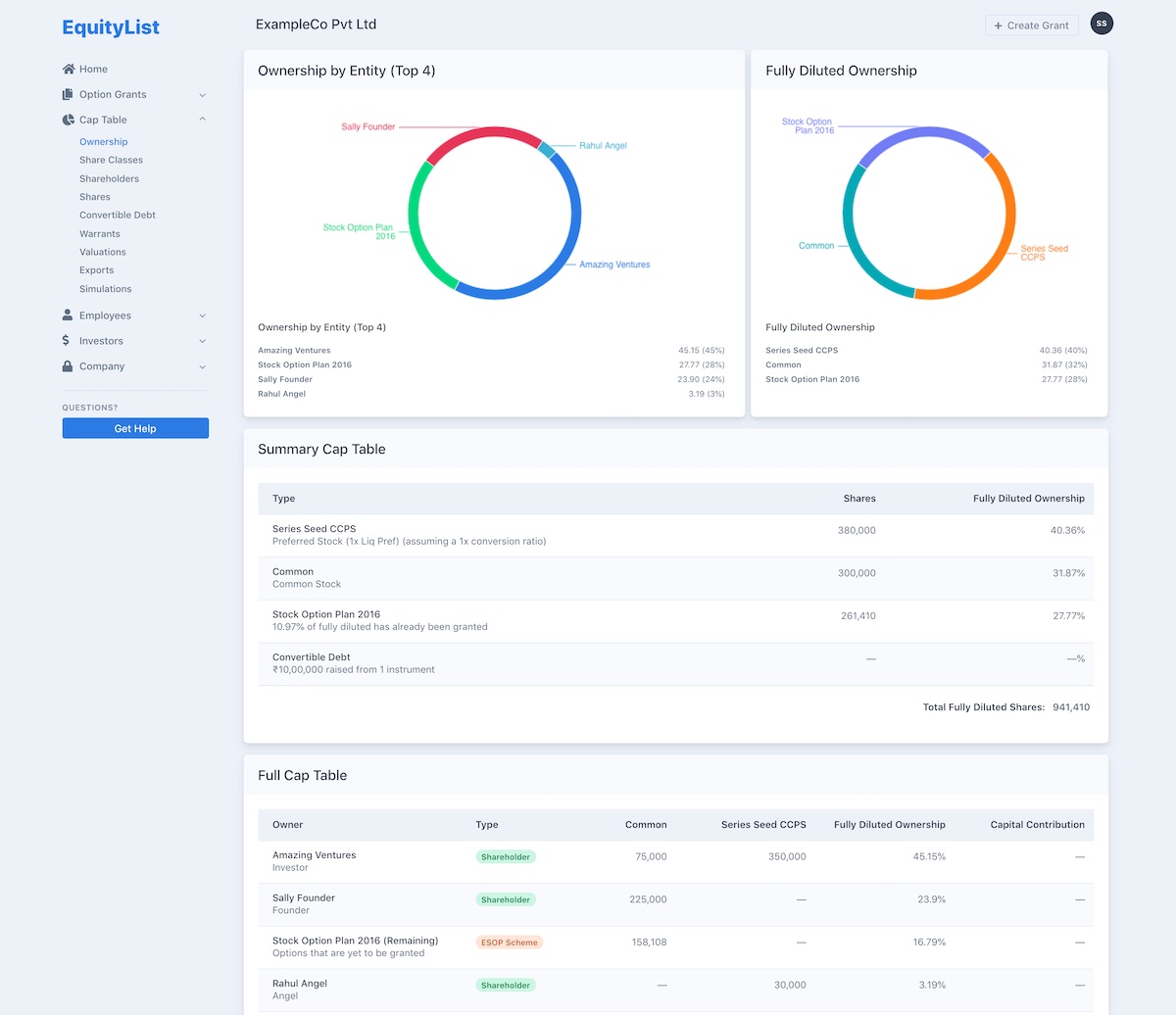
The startup platform said its new product, called EquityList, allows founders to easily manage their cap table, which as the name suggests, is a table that documents a firm’s percentages of ownership, value of equity in each round, and equity dilution.
AngelList’s new offering pits it against the talk-of-the-town Carta’s core service — though by limiting EquityList to India, AngelList is tapping a booming market that the Palo Alto-based startup is yet to explore.
By targeting India, AngelList is also ploughing through a field that is vast but doesn’t have as many challengers. Most startups in India currently rely on lawyers, papers, and Microsoft Excel to manage their cap tables.
EquityList also enables startup founders to manage equity they are granting to employees. The tool, which allows the grant letter to generate and deliver in a single-click, also enables startup employees to accept the grant, view its value, and make use of it, explained Sumukh Sridhara, who oversees product and engineering at AngelList India, in an interview.
“It’s actually cumbersome to keep track of the numbers in Excel,” said Rajan Bajaj, founder and chief executive of SlicePay, a Bangalore-based startup that offers payment cards with pre-approved credit lines for students, gig-workers, freelancers and startup employees.
“Equity of a startup is perhaps the fastest growing asset in the world and it makes sense to manage it with a digital ledger like your stock broking account,” he said.
Utsav Somani, who oversees AngelList’s India operations, said the platform is making EquityList available to startups at no charge. In an interview with TechCrunch, he said EquityList will help startups save countless hours and capital that currently goes into legal documentations.
“Several Indian startups have become unicorns over the years and many more are moving to join the list. But employees at these startups don’t really know what’s the worth of their paper stake, and what they can do about it,” he said. “Employees need to feel that they are valuable. In the U.S. and other markets with more mature startup ecosystems, employees are up to speed on these matters,” he said.
During its pre-beta days, 20 startups ranging from pre-Seed to Series B used EquityList and the early reception was overwhelming, said AngelList, adding that startups using EquityList don’t share any data with the platform.
Misbah Ashraf, co-founder and chief executive of Marsplay, a New Delhi-based startup that operates a social app where influencers showcase beauty and apparel content to sell to consumers, agreed. “There is a lack of transparency everywhere with stock options and how ESOPs’ (Employee Stock Option Plans) value is changing,” he said.
Miten Sampat, chief strategy officer at Times Internet, said it was only logical that AngelList looked into this category, and that it was high time that more firms addressed these challenges. AngelList is also well-positioned to scale this in the market, he said.
A venture capitalist, who did not wish to be identified, said he wasn’t surprised that AngelList was making EquityList free. “They want to be the system of record, a standard for the market. They want startups, and other venture capitalist funds to use EquityList.”
Somani agrees. He said EquityList would enable AngelList, which launched in the nation a year and a half ago, to gain trust and credibility with startups and other players in the ecosystem.
Another venture capitalist who also spoke on the condition of anonymity as he did not wish to upset others said that while EquityList appears to be replicating ‘Carta for India’ and address real challenges but that India was not that big of a market — which would explain why Carta has no play here.
“India is a big and wide-open market,” said Somani, who launched his micro VC fund last month. He added that AngelList would eventually expand EquityList to other markets.
Times Internet’s Sampat said EquityList also paves way for AngelList to perhaps explore becoming a secondary private market for startups one day. Somani did not rule out the possibility, but said there are enough regulatory hurdles to work out first.


Comments
Post a Comment