https://www.highperformancecpmgate.com/rgeesizw1?key=a9d7b2ab045c91688419e8e18a006621

Memo Bank unveils its business bank, credit license and $22.5 million in new funding

Memo Bank wasn’t always called Memo Bank. It originally started as Margo Bank and it has been flying under the radar for a few years. The French startup is now about to launch publicly and shared more details about what it is building.

As the name suggests, Memo Bank is a bank. It plans to server business customers exclusively and it targets small and medium companies that generate over €2 million in annual turnover and have more than 10 employees.

Jean-Daniel Guyot, the co-founder and CEO of Memo Bank, previously founded Capitaine Train, which later became Captain Train, which later was acquired by Trainline. Capitaine Train disrupted online train ticket sales in France as the national railway company basically had a monopoly.

When you’re creating a bank, you’re also entering a highly regulated market. And Memo Bank’s team is aware of that and wants to create a barrier to entry with its competitors while providing a different service compared to legacy players.

Memo Bank is a credit institution and has obtained the proper licenses from the French regulator (ACPR) and the European Central Bank. “It’s a unique event in France, it hasn’t happened since 1970,” Guyot said in a press conference.

“You don’t build a bank in a garage with a few thousand euros,” he added in order to set his startup apart from other fintech startups.

The startup has raised a $22.5 million (€20 million) funding round from BlackFin Capital Partners, existing investor Daphni and Bpifrance. Founders Future and a ton of business angels are also joining the round — Alexis Bonillo, Antoine Martin, Marc Simoncini, Nicolas Steegmann, Oleg Tscheltzoff, Paulin Dementhon, Pierre Valade, Rachel Delacour, Sarah Meyohas, Thibaud Elzière, Xavier Niel…

The former CEO of Arkéa Ronan Le Moal is also taking a seat at the table as chairman of the board. Memo Bank had previously raised $7.6 million (€6.7 million) in 2018.
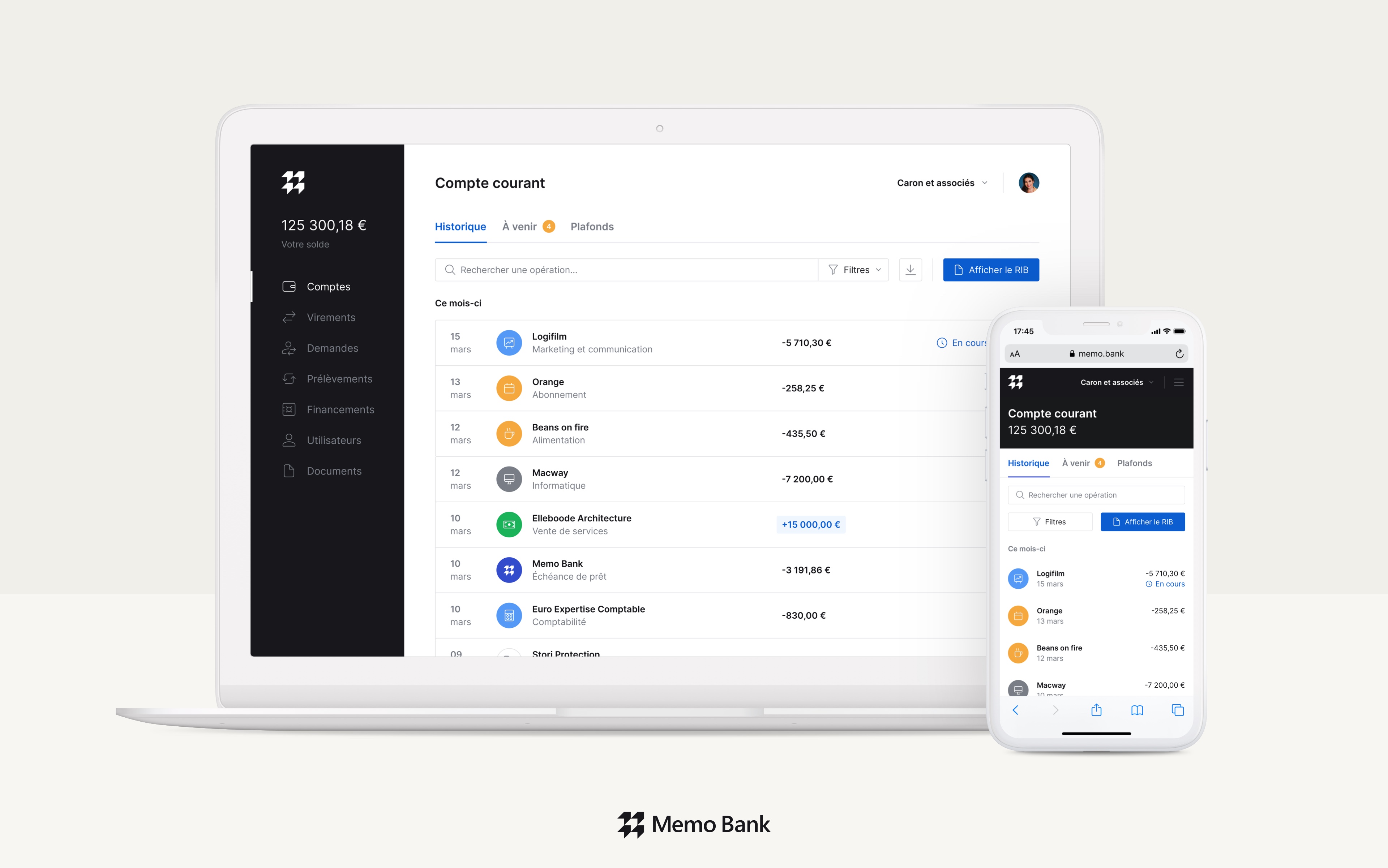
So what is Memo Bank exactly? You’ll have to wait a few months if you want to become a client. The company has developed its own core banking infrastructure and wants to offer everything you’d expect from a business bank.

It starts with a bank account that doesn’t suck. “It seems obvious but believe me it’s not,” Guyot said. Many business banks don’t let you add team members without sending a letter. Or you can’t browse transactions that are older than three months in the web interface.

But the real product is credit. Memo Bank wants to offer credit lines in just a few days without any cumbersome paperwork. Memo Bank’s biggest competitor isn’t neobanks. The startup is competing directly with online lending platforms, such as October.

At first, Memo Bank is going to accept clients in the Paris area. While the company won’t have any physical branch, it wants to be able to come and talk to you directly. It’ll expand to Lyon and then other French cities in the next years. Eventually, Memo Bank hopes it can attract 4,000 clients within four years.

Comments

Popular posts from this blog

Uber co-founder Garrett Camp steps back from board director role

Uber co-founder Garrett Camp is relinquishing his role as a board director and switching to board observer — where he says he’ll focus on product strategy for the ride hailing giant. Camp made the announcement in a short Medium post in which he writes of his decade at Uber: “I’ve learned a lot, and realized that I’m most helpful when focused on product strategy & design, and this is where I’d like to focus going forward.” “I will continue to work with Dara [Khosrowshahi, Uber CEO] and the product and technology leadership teams to brainstorm new ideas, iterate on plans and designs, and continue to innovate at scale,” he adds. “We have a strong and diverse team in place, and I’m confident everyone will navigate well during these turbulent times.” The Canadian billionaire entrepreneur signs off by saying he’s looking forward to helping Uber “brainstorm the next big idea”. Camp hasn’t been short of ideas over his career in tech. He’s the co-founder of the web 2.0 recommendatio...

How the world’s largest cannabis dispensary avoids social media restrictions

Planet 13 is the world’s largest cannabis dispensary. Located in Las Vegas, blocks off the Strip, the facility is the size of a small Walmart. By design, it’s hard to miss. Planet 13 is upending the dispensary model. It’s big, loud and visitors are encouraged to photograph everything. As part of the cannabis industry, Planet 13 is heavily restricted on the type of content it can publish on Instagram, Facebook and other social media platforms. It’s not allowed to post pictures of buds or vapes on some sites. It can’t talk about pricing or product selection on others.   View this post on Instagram   A post shared by Morgan Celeste SF Blogger (@bayareabeautyblogger) on Jan 25, 2020 at 7:54pm PST Instead, Planet 13 encourages its thousands of visitors to take photos and videos. Starting with the entrance, the facility is full of surprises tailored for the ‘gram. As a business, Planet 13’s social media content is heavily restricted a...

Billionaire clothing dynasty heiress launches Everybody & Everyone to make fashion sustainable

Veronica Chou’s family has made its fortune at the forefront of the fast fashion business through investments in companies like Michael Kors and Tommy Hilfiger . But now, the heiress to an estimated $2.1 billion fortune is launching her own company, Everybody & Everyone , to prove that the fashion industry can be both environmentally sustainable and profitable. There’s no argument about the negative impacts of the fashion industry on the environment. The textiles industry primarily uses non-renewable resources — on the order of 98 million tons per year. That includes the oil to make synthetic fibers, fertilizers to grow cotton, and toxic chemicals to dye, treat, and produce the textiles used to make clothes. The greenhouse gas footprint from textiles production was roughly 1.2 billion tons of CO2 equivalent in 2015 — more than all international flights and maritime shipments combined (and a lot of those maritime shipments and international flights were hauling clothes). The lit...