https://www.highperformancecpmgate.com/rgeesizw1?key=a9d7b2ab045c91688419e8e18a006621

Wonder Woman's Most Powerful Form Came from Marvel's Mjolnir

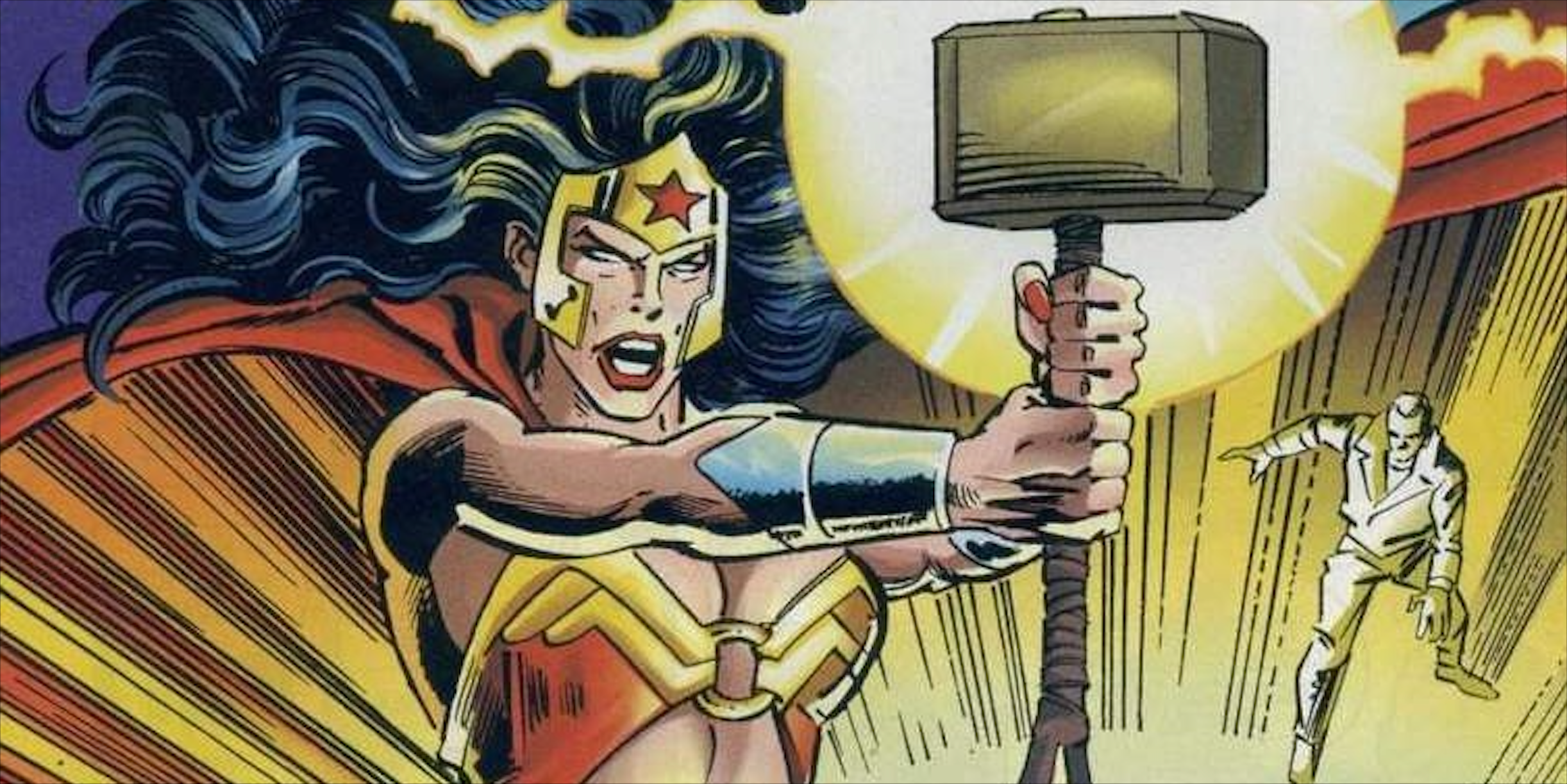
Already one of DC's powerhouses, Wonder Woman's ultimate form was achieved thanks to her discovery of Marvel's Mjolnir. Displaced due to Thor's previous battle with Shazam, the mythological hammer lay undisturbed until Wonder Woman discovered it and learned that she was worthy of its power. While heroes and villains battled for the survival of their worlds in DC vs Marvel, this ultimate form of Wonder Woman not only showcased the best of both worlds but foreshadowed events yet to come in the legendary crossover series.

In the series by Ron Marz, Peter David, Dan Jurgen, and Claudio Castellini, both comic book worlds experience a massive dimensional breach that has heroes and villains randomly disappearing and reappearing in new universes. While some fought and others worked together, all were left trying to make sense of the madness, only to learn it was all the precursor to a contest unlike any other. Two beyond powerful entities similar to brothers had discovered each other and sought to prove who was better by pitting hand-selected champions against each other, the winner would be allowed to live while the loser would be wiped from existence. While Wonder Woman had been seen briefly in DC vs Marvel #1, her most important role in this unfolding conflict was about to be revealed.


In DC vs Marvel #2, Wonder Woman came across Thor's hammer Mjolnir, which had been temporarily lost after colliding with Shazam's magical lightning bolt. Recognizing it as an ancient Norse hammer, Princess Diana of Themyscira read the inscription carved into the iconic weapon and called out its unrealistic expectations about deeming who was worthy and who was not. When she attempted to pick it up almost as if to prove her point, Wonder Woman was surprised to see Mjolnir emit powerful energy and near the end of the issue, she appeared not only wielding its power but also sporting a new wardrobe as well.
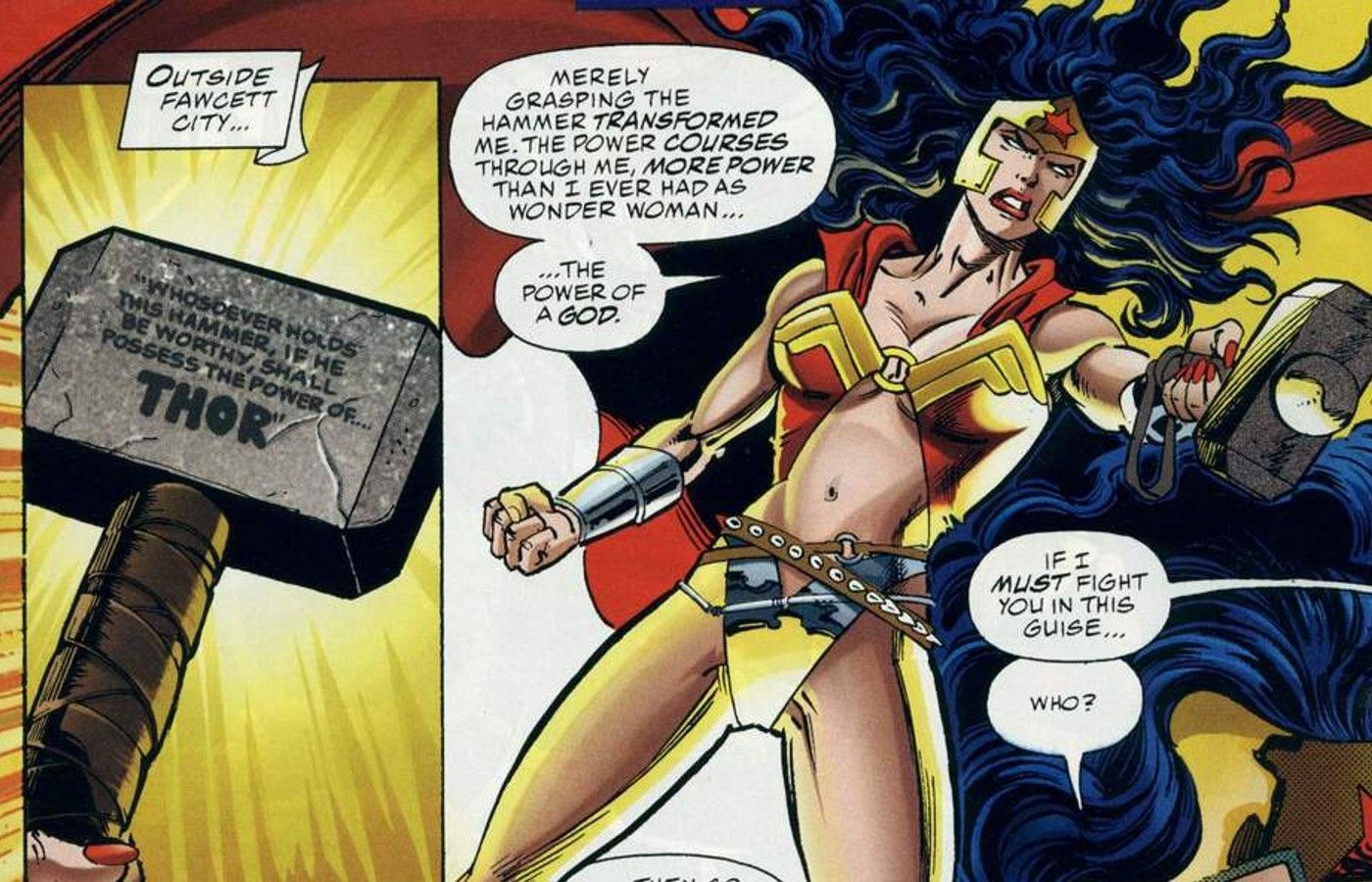


Although this new form would be short-lived and wrapped up by Marvel vs DC #3, this ultimate form of Wonder Woman was not only a significant upgrade to one of DC's most recognized heroes but also a unique amalgamation of both universes. Her new outfit was argued to be one of her worst, but Wonder Woman still had her superhuman abilities and Mjolnir added the ability to control the weather along with other powerful abilities that technically made her the new Goddess of Thunder a decade or two before Jane Foster took on the role. This change may have also been a deliberate foreshadowing to when the series caused both universes to merge, creating the Amalgam Universe, which saw new characters created as mash-ups of Marvel and DC characters.

It was actually thanks to X-Men's Storm that this new form didn't last long. Confronting the powerful Amazon warrior, Storm not only says that she's ready to battle, but that she'd fight Diana even with her new advantage. Although Mjolnir may have reduced Storm's threat to another rainy day, Wonder Woman felt that such an advantage was not fair, loosening her grip so she could fight Storm, ultimately losing the hammer. Although her defeat by Storm was heavily debated despite being determined by fans, one can only wonder what could have happened if she had used Mjolnir after all.

Comments

Popular posts from this blog

Uber co-founder Garrett Camp steps back from board director role

Uber co-founder Garrett Camp is relinquishing his role as a board director and switching to board observer — where he says he’ll focus on product strategy for the ride hailing giant. Camp made the announcement in a short Medium post in which he writes of his decade at Uber: “I’ve learned a lot, and realized that I’m most helpful when focused on product strategy & design, and this is where I’d like to focus going forward.” “I will continue to work with Dara [Khosrowshahi, Uber CEO] and the product and technology leadership teams to brainstorm new ideas, iterate on plans and designs, and continue to innovate at scale,” he adds. “We have a strong and diverse team in place, and I’m confident everyone will navigate well during these turbulent times.” The Canadian billionaire entrepreneur signs off by saying he’s looking forward to helping Uber “brainstorm the next big idea”. Camp hasn’t been short of ideas over his career in tech. He’s the co-founder of the web 2.0 recommendatio...

How the world’s largest cannabis dispensary avoids social media restrictions

Planet 13 is the world’s largest cannabis dispensary. Located in Las Vegas, blocks off the Strip, the facility is the size of a small Walmart. By design, it’s hard to miss. Planet 13 is upending the dispensary model. It’s big, loud and visitors are encouraged to photograph everything. As part of the cannabis industry, Planet 13 is heavily restricted on the type of content it can publish on Instagram, Facebook and other social media platforms. It’s not allowed to post pictures of buds or vapes on some sites. It can’t talk about pricing or product selection on others.   View this post on Instagram   A post shared by Morgan Celeste SF Blogger (@bayareabeautyblogger) on Jan 25, 2020 at 7:54pm PST Instead, Planet 13 encourages its thousands of visitors to take photos and videos. Starting with the entrance, the facility is full of surprises tailored for the ‘gram. As a business, Planet 13’s social media content is heavily restricted a...

Billionaire clothing dynasty heiress launches Everybody & Everyone to make fashion sustainable

Veronica Chou’s family has made its fortune at the forefront of the fast fashion business through investments in companies like Michael Kors and Tommy Hilfiger . But now, the heiress to an estimated $2.1 billion fortune is launching her own company, Everybody & Everyone , to prove that the fashion industry can be both environmentally sustainable and profitable. There’s no argument about the negative impacts of the fashion industry on the environment. The textiles industry primarily uses non-renewable resources — on the order of 98 million tons per year. That includes the oil to make synthetic fibers, fertilizers to grow cotton, and toxic chemicals to dye, treat, and produce the textiles used to make clothes. The greenhouse gas footprint from textiles production was roughly 1.2 billion tons of CO2 equivalent in 2015 — more than all international flights and maritime shipments combined (and a lot of those maritime shipments and international flights were hauling clothes). The lit...